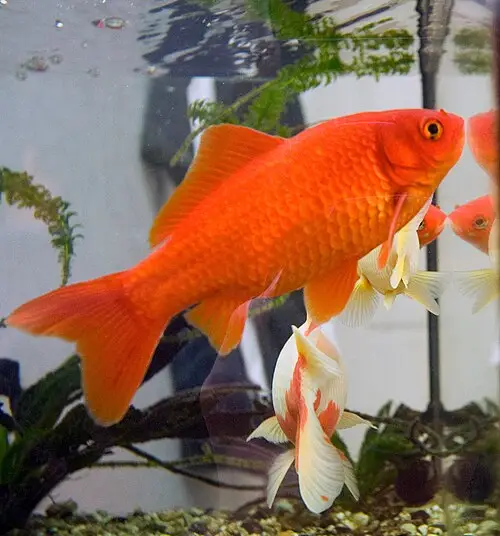
 📸 Photo
Photo: No machine-readable author provided. Heptagon assumed (based on copyright claims). · Public domain · Wikimedia Commons Source
Goldfish
Carassius auratus (Goldfish · キンギョ)
💡 Everyday Comparisons for Size, Mass & Speed
- 💡 Its maximum total length of 48 cm is more than one and a half 30 cm rulers (Comparison).
- 💡 Its maximum weight of 1.6 kg is similar to the weight of a 1.5 L bottle of water (Comparison).
- 💡 It is among the most commonly sold aquarium fishes and is also sold as bait for catching larger fish. Prices range from 15 cents for feeder goldfish to 120 dollars for rare varieties (ADW).
- 💡 It is also found in rice paddy irrigation canals and reservoirs (National List of Species of Korea).
Reference standards: coach bus ~12 m, mid-size car ~4.9 m, compact car ~1 t, basketball hoop 3.05 m, credit card 8.56 cm.
Site-computed relative index from recorded values; not a formal scientific metric.
📖 1. Overview
Carassius auratus is a freshwater fish native to East Asia that shares the English name Goldfish. In Korea, it can be seen in rivers and reservoirs nationwide.
🦴 2. Anatomy & Morphology
Its body is flattened from side to side, it has no barbels around the mouth, and the rear edge of the tail fin is deeply forked. Its body color varies by habitat, showing a bluish tint in flowing water and a yellowish tint in standing water.
🔍 3. Ecology & Behavior
It is an omnivore that eats almost all organic matter, including small crustaceans, rotifers, insect larvae, and plant seeds. It lays eggs on aquatic plants and has a habit of living in schools.
🇰🇷 4. Connection to Korea
It is listed on the National List of Species of Korea and lives in freshwaters nationwide, including rivers, reservoirs, and rice paddy irrigation canals.
📚 Sources & References
- • IUCN Red List LC (2013) — https://www.iucnredlist.org/species/166083/1110472
- • IUCN Red List category LC — latest assessment at iucnredlist.org
- • catalogueoflife.org — 68ZXN
- • iucnredlist.org — 1110472
- • 국가생물종목록(국립생물자원관) ktsn 120000057547 — https://species.nibr.go.kr/home/mainHome.do?cont_link=009&subMenu=009002&contCd=009002&ktsn=120000057547
- • wikidata.org — Q123141
- • commons.wikimedia.org — File:Goldfish3.jpg
- • fishbase.se — Carassius-auratus.html
- • species.nibr.go.kr — mainHome.do
- • animaldiversity.org — Carassius auratus
- • Silhouette: PhyloPic — Fidji Berio · CC0 1.0
Recorded dimensions are widely cited representative estimates from public literature and may vary by study or specimen.