 📸 Photo
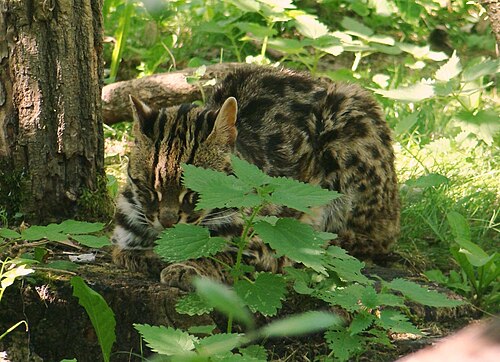
Bengal leopard cat ( Prionailurus bengalensis bengalensis ) at the feline park
Photo: Abujoy · CC BY-SA 3.0 · Wikimedia Commons Source
Leopard Cat
Prionailurus bengalensis (Leopard Cat · ベンガルヤマネコ)
💡 Everyday Comparisons for Size, Mass & Speed
- 📏 Length 45cm — ~1.5× the long side of an A4 sheet (29.7 cm)
- ⚖️ Mass 3kg — Equivalent to ~1.5 two-liter water bottles (2 kg each)
- ⚡ Speed 50km/h — ~1.3× Usain Bolt's 100 m world-record average speed (37.6 km/h)
Reference standards: coach bus ~12 m, mid-size car ~4.9 m, compact car ~1 t, basketball hoop 3.05 m, credit card 8.56 cm.
Site-computed relative index from recorded values; not a formal scientific metric.
📖 1. Overview
With tigers and leopards gone, it is the only native wild felid serving as the top predator in South Korea's natural ecosystems today.
🌐 Wikipedia Summary ExtractThe leopard cat is a small wild cat with dark spots on the tawny-coloured body and limbs. It has two dark stripes running from the eyes to the ears and smaller white streaks running from the eyes to the nose, and two to four rows of elongated spots along its back. Its tail is about half the size of its head-to-body length.
🦴 2. Anatomy & Morphology
It is characterized by two distinct vertical white stripes on its forehead, white spots on the back of its ears (identical to tiger ear spots), and a thick striped tail.
🔍 3. Ecology & Behavior
Skilled at swimming, it hunts field mice, fish, and amphibians around wetlands.
🇰🇷 4. Connection to Korea
Designated as Class II endangered wildlife (Korea) by the Ministry of Environment, it is a primary target for wildlife corridor protection at Upo Wetland and Sihwaho Lake.
📚 Sources & References
- • Wikipedia “Leopard cat”
- • Wikidata Q42627
- • IUCN Red List category LC — latest assessment at iucnredlist.org
- • nie.re.kr — view.do
- • Silhouette: PhyloPic — Andy Wilson · CC0 1.0 (Congeneric silhouette — Prionailurus viverrinus)
Recorded dimensions are widely cited representative estimates from public literature and may vary by study or specimen.