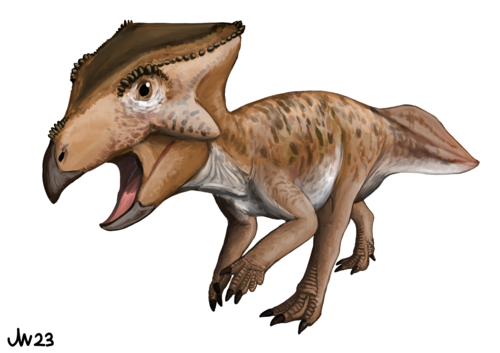
 🎨 Restoration
Life reconstruction of Koreaceratops
Restoration: Jun-Hyeok Jang · CC BY-SA 4.0 · Wikimedia Commons Source
Life restorations are artistic reconstructions based on fossil evidence; true coloration and soft-tissue details remain uncertain.
Koreaceratops hwaseongensis
Koreaceratops hwaseongensis (Koreaceratops hwaseongensis · コリアケラトプス)
Known only from fossils. The IUCN Red List assesses only species extant since 1500 CE, so fossil taxa are not assigned a category.
💡 Everyday Comparisons for Size, Mass & Speed
- 📏 Length 1.8m — ~1× the height of a 1.75 m adult human
- ⚖️ Mass 45kg — Equivalent to ~22.5 two-liter water bottles (2 kg each)
- ⚡ Speed 28km/h — ~0.7× Usain Bolt's 100 m world-record average speed (37.6 km/h)
Reference standards: coach bus ~12 m, mid-size car ~4.9 m, compact car ~1 t, basketball hoop 3.05 m, credit card 8.56 cm.
Site-computed relative index from recorded values; not a formal scientific metric.
📖 1. Overview
Excavated at Jeongok Port in Hwaseong-si, Gyeonggi-do in 2008, it is Korea's representative horned dinosaur whose scientific name incorporates both "Korea" and "Hwaseong."
🌐 Wikipedia Summary ExtractKoreaceratops is a genus of basal ceratopsian dinosaur discovered in Albian-aged rocks of South Korea.
🦴 2. Anatomy & Morphology
A semi-aquatic ceratopsian skilled at swimming, with tall neural spines on its tail vertebrae rising like a fan.
🔍 3. Fossil Record & Paleoecology
It is a world-renowned specimen that shed light on the evolutionary transition from primitive bipedal ceratopsians to large quadrupedal ceratopsians.
🇰🇷 4. Connection to Korea
It is a representative real skeletal fossil of the Korean Peninsula symbolizing the Hwaseong Dinosaur Egg Fossil Site.
📚 Sources & References
- • Wikipedia “Koreaceratops”
- • Wikidata Q134260
- • Fossil taxon — the IUCN Red List assesses only species living or extinct since 1500
- • Silhouette: PhyloPic — Jun-Hyeok Jang · Public Domain Mark 1.0
Recorded dimensions are widely cited representative estimates from public literature and may vary by study or specimen.