 📸 Photo
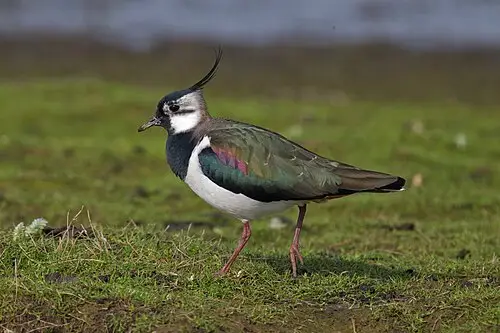
Photo: Andreas Trepte · CC BY-SA 2.5 · Wikimedia Commons Source
Northern Lapwing
Vanellus vanellus (Northern Lapwing · タゲリ)
💡 Everyday Comparisons for Size, Mass & Speed
- 💡 Its maximum weight of 330 g is lighter than a 500 mL bottle of water (Comparison).
- 💡 In winter, it can be met in small flocks on harvested rice paddies or along riversides (National List of Species of Korea).
- 💡 In countries such as Iran, France, Italy, Greece, and Spain, it is also hunted for food and sport (Animal Diversity Web).
Reference standards: coach bus ~12 m, mid-size car ~4.9 m, compact car ~1 t, basketball hoop 3.05 m, credit card 8.56 cm.
Site-computed relative index from recorded values; not a formal scientific metric.
📖 1. Overview
The Northern Lapwing is a plover with an upturned crest on the back of its head that breeds across mid-latitude Eurasia and winters in southern Europe, North Africa, southern China, Japan, and Korea.
🦴 2. Anatomy & Morphology
Its head and upper breast are black with a metallic green sheen, and a slender, long crest rises from the back of the head. Its belly is white and its wings are broad and rounded.
🔍 3. Ecology & Behavior
It feeds on insects, earthworms, crustaceans, seeds, and fruits, tapping the ground with its feet to draw out prey. It makes a shallow saucer-shaped nest on grassy ground and lays eggs from late March to late May.
🇰🇷 4. Connection to Korea
It is a common winter visitor arriving in small flocks to winter in rice paddies, reservoirs, rivers, and estuaries in central and southern Korea.
📚 Sources & References
- • IUCN Red List NT (2025) — https://www.iucnredlist.org/species/22693949/205921412
- • IUCN Red List category NT — latest assessment at iucnredlist.org
- • doi.org — avilist.v2026
- • iucnredlist.org — 205921412
- • 국가생물종목록(국립생물자원관) ktsn 120000001669 — https://species.nibr.go.kr/home/mainHome.do?cont_link=009&subMenu=009002&contCd=009002&ktsn=120000001669
- • wikidata.org — Q25392
- • commons.wikimedia.org — File:Northern-Lapwing-Vanellus-vanellus.jpg
- • animaldiversity.org — Vanellus vanellus
- • species.nibr.go.kr — mainHome.do
- • Silhouette: PhyloPic — Nina Skinner · CC BY 3.0
Recorded dimensions are widely cited representative estimates from public literature and may vary by study or specimen.