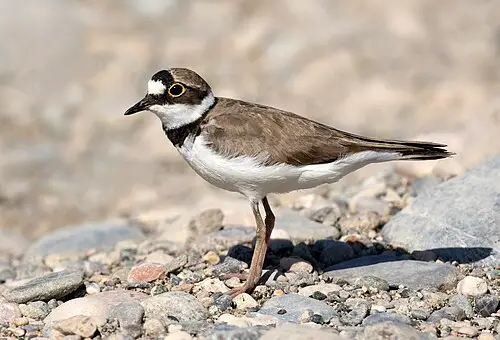
 📸 Photo
Photo: Zeynel Cebeci · CC BY-SA 4.0 · Wikimedia Commons Source
Little Ringed Plover
Thinornis dubius (Little Ringed Plover · Little Ringed Plover)
Not Evaluated (NE) on the IUCN Red List yet.
💡 Everyday Comparisons for Size, Mass & Speed
- 💡 Its body length of 16 cm is similar to the length of a smartphone (about 15 cm) (Comparison).
- 💡 The small bird seen running in quick, short steps and suddenly pausing on riverside gravel bars or reclaimed flats is the Little Ringed Plover (National List of Species of Korea).
- 💡 When someone approaches a nest with chicks, it droops its wings and pretends to be injured to lead people or predators away from the nest (National List of Species of Korea).
Reference standards: coach bus ~12 m, mid-size car ~4.9 m, compact car ~1 t, basketball hoop 3.05 m, credit card 8.56 cm.
📖 1. Overview
The Little Ringed Plover is a small plover 16 cm in body length that is a common summer visitor in Korea. It breeds in temperate and subarctic zones of the Northern Hemisphere and in New Guinea, and winters in Africa, India, and Southeast Asia.
🦴 2. Anatomy & Morphology
A distinct yellow eye-ring sets it apart from other plovers. It has black markings in front of the eyes, on the crown, on the ear coverts, and across the breast, and its bill is shorter than that of the Long-billed Plover.
🔍 3. Ecology & Behavior
It feeds mainly on insects, running quickly in short steps before stopping abruptly to seize prey. It makes a nest on gravel flats, lays 4 eggs, and incubates them for 24–25 days. When an intruder approaches the nest, it feigns injury to lure the predator away.
🇰🇷 4. Connection to Korea
It is a common summer visitor that arrives from mid-March to breed on gravelly riverbanks, small streams, and reclaimed lands across Korea.
📚 Sources & References
- • IUCN Red List: not evaluated (NE) — cross-checked with the Wikidata conservation-status entry
- • doi.org — avilist.v2026
- • 국가생물종목록(국립생물자원관) ktsn 120000155047 — https://species.nibr.go.kr/home/mainHome.do?cont_link=009&subMenu=009002&contCd=009002&ktsn=120000155047
- • wikidata.org — Q531118
- • species.nibr.go.kr — mainHome.do
- • Silhouette: PhyloPic — Rachel T Mason · CC0 1.0 (Congeneric silhouette — Thinornis cucullatus)
Recorded dimensions are widely cited representative estimates from public literature and may vary by study or specimen.