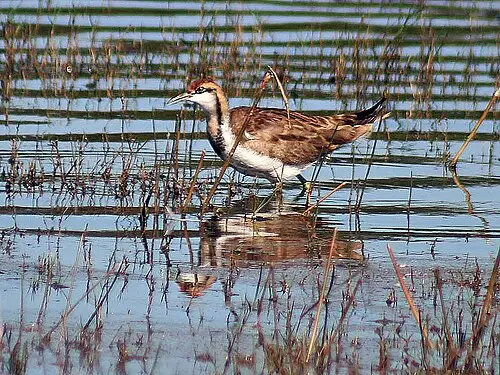
 📸 Photo
Photo: J.M.Garg · CC BY-SA 3.0 · Wikimedia Commons Source
Pheasant-tailed Jacana
Hydrophasianus chirurgus (Pheasant-tailed Jacana · レンカク)
💡 Everyday Comparisons for Size, Mass & Speed
- 💡 Because reservoirs filled with prickly water lilies are prime habitats for the Pheasant-tailed Jacana, it is a bird that can be encountered near lotus-filled ponds (National List of Species of Korea).
- 💡 Its long, trailing tail and long toes are the easiest features for distinguishing this bird from other waterbirds (National List of Species of Korea).
- 💡 Northern populations migrate south while southern populations stay year-round, so the season when it is seen differs by region (National List of Species of Korea).
Reference standards: coach bus ~12 m, mid-size car ~4.9 m, compact car ~1 t, basketball hoop 3.05 m, credit card 8.56 cm.
📖 1. Overview
The Pheasant-tailed Jacana is a waterbird characterized by its long tail, long toes, and long neck. It lives in reservoirs and areas densely covered with prickly water lilies, and is distributed south of the Yangtze River in China and in Kyushu, Japan.
🦴 2. Anatomy & Morphology
Its hindneck is pale yellow, its face, foreneck, and upper breast are white, and its lower breast, back, and wings are black. Its finely attenuated primary wing feathers and long tail are distinctive.
🔍 3. Ecology & Behavior
Within its range, northern breeding populations migrate south, whereas southern breeding populations are sedentary residents.
🇰🇷 4. Connection to Korea
It is listed under the name "Mul-kkwong" (Korean name) in the National List of Species of Korea (National Institute of Biological Resources (NIBR)) and is described as a bird living along watersides such as reservoirs.
📚 Sources & References
- • IUCN Red List LC (2024) — https://www.iucnredlist.org/species/22693543/264999616
- • IUCN Red List category LC — latest assessment at iucnredlist.org
- • doi.org — avilist.v2026
- • iucnredlist.org — 264999616
- • 국가생물종목록(국립생물자원관) ktsn 120000001688 — https://species.nibr.go.kr/home/mainHome.do?cont_link=009&subMenu=009002&contCd=009002&ktsn=120000001688
- • wikidata.org — Q18861
- • commons.wikimedia.org — File:Pheasant tailed Jacana (Non-breeding) I IMG 8638.jpg
- • species.nibr.go.kr — mainHome.do
- • Silhouette: PhyloPic — Burton Robert, USFWS · CC0 1.0 (Related taxon silhouette — Jacana spinosa)
Recorded dimensions are widely cited representative estimates from public literature and may vary by study or specimen.