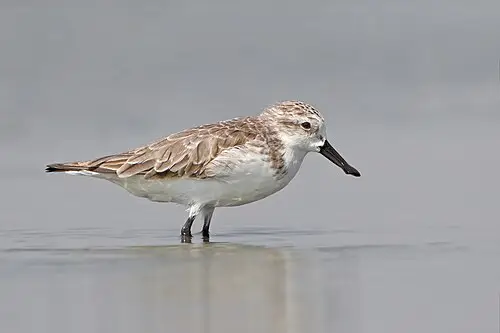
 📸 Photo
Photo: JJ Harrison ( https://www.jjharrison.com.au/ ) · CC BY-SA 3.0 · Wikimedia Commons Source
Spoon-billed Sandpiper
Calidris pygmaea (Spoon-billed Sandpiper · ヘラシギ)
💡 Everyday Comparisons for Size, Mass & Speed
- 💡 Its body length of 14.5 cm is similar in size to one ballpoint pen (about 14 cm) (Comparison).
- 💡 As west coast tidal flats used as migration stopovers have shrunk due to reclamation and development, the number of breeding-age individuals fell to about 490 based on 2014–2019 data (National Institute of Ecology).
- 💡 The loss of west coast tidal flats leads directly to the threat of extinction for this small bird (National Institute of Ecology).
Reference standards: coach bus ~12 m, mid-size car ~4.9 m, compact car ~1 t, basketball hoop 3.05 m, credit card 8.56 cm.
📖 1. Overview
The spoon-billed sandpiper is a small sandpiper with a spoon-shaped bill tip that breeds in the Russian Far East and migrates along the East Asian coast to winter in Bangladesh, Myanmar, Thailand, and nearby regions.
🦴 2. Anatomy & Morphology
It is 14.5 cm long with a black bill that widens like a spoon at the tip. Its head and breast are reddish-brown in summer while its upperparts turn pale grey in winter, and its legs are always black.
🔍 3. Ecology & Behavior
During the breeding season it eats insects such as moths, mosquitoes, flies, and spiders, and during migration it feeds on polychaete worms and small shrimp. It lays about 4 eggs from late June (month 6) to mid-July (month 7).
🇰🇷 4. Connection to Korea
Very small numbers pass through tidal flats and estuaries on the west and south coasts during spring and autumn migration, mainly seen at Yubudo Island and the Nakdonggang Estuary. Only 25 individuals were recorded from 2017 to 2020.
📚 Sources & References
- • IUCN Red List CR (2021) — https://www.iucnredlist.org/species/22693452/154738156
- • IUCN Red List category CR — latest assessment at iucnredlist.org
- • doi.org — avilist.v2026
- • iucnredlist.org — 154738156
- • 국가생물종목록(국립생물자원관) ktsn 120000528817 — https://species.nibr.go.kr/home/mainHome.do?cont_link=009&subMenu=009002&contCd=009002&ktsn=120000528817
- • wikidata.org — Q28065684
- • commons.wikimedia.org — File:Eurynorhynchus pygmeus 2 - Pak Thale.jpg
- • nie.re.kr — view.do
- • Silhouette: PhyloPic — Edwin Price · CC0 1.0 (Congeneric silhouette — Calidris pugnax)
Recorded dimensions are widely cited representative estimates from public literature and may vary by study or specimen.