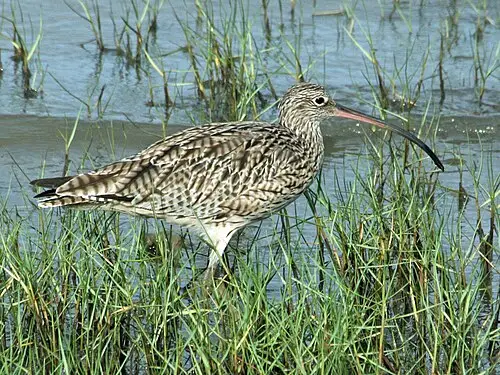
 📸 Photo
Photo: DickDaniels ( http://theworldbirds.org/ ) · CC BY-SA 3.0 · Wikimedia Commons Source
Far Eastern Curlew
Numenius madagascariensis (Far Eastern Curlew · ホウロクシギ)
🇰🇷 Class II endangered wildlife (Korea)
💡 Everyday Comparisons for Size, Mass & Speed
- 💡 Its body length of about 63 cm is about 2 times the long side of an A4 sheet of paper (29.7 cm) (Comparison).
- 💡 Its weight of about 0.9 kg is slightly lighter than a 1 L carton of milk (about 1 kg) (Comparison).
Reference standards: coach bus ~12 m, mid-size car ~4.9 m, compact car ~1 t, basketball hoop 3.05 m, credit card 8.56 cm.
Site-computed relative index from recorded values; not a formal scientific metric.
📖 1. Overview
The Far Eastern Curlew is a large curlew that breeds in Siberia, northern China, and Kamchatka and winters on tidal flats in Japan, China, and Australia. It is listed as Endangered (EN) by the IUCN and has declined by 81% over 30 years in Australia.
🦴 2. Anatomy & Morphology
At about 63 cm in body length, it is the largest shorebird visiting New Zealand. Its bill is long, slender, and curved downward, and females are larger than males with a longer bill.
🔍 3. Ecology & Behavior
On tidal flats, it uses its long bill to pull crabs out of burrows, detaching their legs before swallowing them. Between 20,000 and 50,000 individuals remain worldwide.
🇰🇷 4. Connection to Korea
In Korea, it is protected as Class II endangered wildlife (Korea).
📚 Sources & References
- • IUCN Red List EN (2024) — https://www.iucnredlist.org/species/22693199/250045646
- • 멸종위기 야생생물 Ⅱ급 — 국가생물종목록(국립생물자원관) ktsn 120000001710 — https://species.nibr.go.kr/home/mainHome.do?cont_link=009&subMenu=009002&contCd=009002&ktsn=120000001710
- • IUCN Red List category EN — latest assessment at iucnredlist.org
- • Korean protection status: Class II endangered wildlife (Korea)
- • doi.org — avilist.v2026
- • iucnredlist.org — 250045646
- • 국가생물종목록(국립생물자원관) ktsn 120000001710 — https://species.nibr.go.kr/home/mainHome.do?cont_link=009&subMenu=009002&contCd=009002&ktsn=120000001710
- • wikidata.org — Q76496
- • commons.wikimedia.org — File:Far Eastern Curlew cairns RWD2.jpg
- • nzbirdsonline.org.nz — eastern-curlew
- • eaaflyway.org — far-eastern-curlew
- • avifauna.hkbws.org.hk — 011700
- • Silhouette: PhyloPic — author not recorded · CC0 1.0
Recorded dimensions are widely cited representative estimates from public literature and may vary by study or specimen.