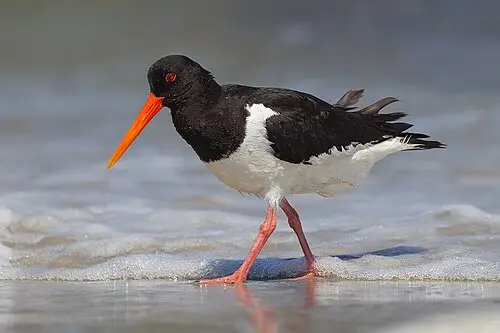
 📸 Photo
Photo: Andreas Trepte · CC BY-SA 2.5 · Wikimedia Commons Source
Eurasian Oystercatcher
Haematopus ostralegus (Eurasian Oystercatcher · ミヤコドリ)
🇰🇷 Class II endangered wildlife (Korea) · Natural Monument (Korea) «Eurasian Oystercatcher»
💡 Everyday Comparisons for Size, Mass & Speed
- 💡 Its weight of about 0.55 kg is roughly 1.3 times the weight of a soccer ball (about 0.43 kg) (Comparison).
- 💡 Its body length of about 45 cm is slightly more than half the length of a baseball bat (about 84 cm) (Comparison).
- 💡 In the United Kingdom, it has even been reported nesting in parking lots and on city rooftops.
Reference standards: coach bus ~12 m, mid-size car ~4.9 m, compact car ~1 t, basketball hoop 3.05 m, credit card 8.56 cm.
Site-computed relative index from recorded values; not a formal scientific metric.
📖 1. Overview
The Eurasian Oystercatcher is a large shorebird living along coasts and estuaries, breeding widely from Iceland and Europe to East Asia. It is listed as Near Threatened (NT) by the IUCN, with a declining population.
🦴 2. Anatomy & Morphology
It is a stocky shorebird measuring 40–45 cm in body length, using its strong bill to pry open or hammer apart bivalve shells.
🔍 3. Ecology & Behavior
It mainly eats bivalves, and in The Wash in the United Kingdom it relies heavily on cockles and mussels in winter. In the United Kingdom, inland breeding sites have increased in addition to coasts, so it is also seen in parking lots and on city rooftops.
🇰🇷 4. Connection to Korea
In Korea, it is a Class II endangered wildlife species (Korea) and was designated as a Natural Monument (Korea) on November 16, 1982. The Hong Kong Bird Watching Society notes that the East Asian subspecies also breeds on the Korean Peninsula.
📚 Sources & References
- • IUCN Red List NT (2019) — https://www.iucnredlist.org/species/22693613/154998347
- • 멸종위기 야생생물 Ⅱ급 · 천연기념물 «검은머리물떼새» — 국가생물종목록(국립생물자원관) ktsn 120000001661 — https://species.nibr.go.kr/home/mainHome.do?cont_link=009&subMenu=009002&contCd=009002&ktsn=120000001661
- • IUCN Red List category NT — latest assessment at iucnredlist.org
- • Korean protection status: Class II endangered wildlife (Korea) · Natural Monument (Korea) «Eurasian Oystercatcher»
- • doi.org — avilist.v2026
- • iucnredlist.org — 154998347
- • 국가생물종목록(국립생물자원관) ktsn 120000001661 — https://species.nibr.go.kr/home/mainHome.do?cont_link=009&subMenu=009002&contCd=009002&ktsn=120000001661
- • heritage.go.kr — culSelectDetail.do
- • wikidata.org — Q25928
- • commons.wikimedia.org — File:Haematopus ostralegus He.jpg
- • rspb.org.uk — oystercatcher
- • bto.org — oystercatcher
- • avifauna.hkbws.org.hk — 009700
- • Silhouette: PhyloPic — Wouter Koch · CC0 1.0
Recorded dimensions are widely cited representative estimates from public literature and may vary by study or specimen.