 📸 Photo
Photo: Unknown author Unknown author · Public domain · Wikimedia Commons Source
Thylacine
Thylacinus cynocephalus (Thylacine · フクロオオカミ)
💡 Everyday Comparisons for Size, Mass & Speed
- 💡 Its maximum weight of 30 kg equals 1.5 bags of 20 kg rice, and its maximum total length of 1.95 m is slightly longer than the width of a passenger car (about 1.8 m) (Comparison).
- 💡 Under the bounty system, trapping them was a major source of income for hunters, and captured individuals were documented as being transported as far as a zoo in New York.
Reference standards: coach bus ~12 m, mid-size car ~4.9 m, compact car ~1 t, basketball hoop 3.05 m, credit card 8.56 cm.
Site-computed relative index from recorded values; not a formal scientific metric.
📖 1. Overview
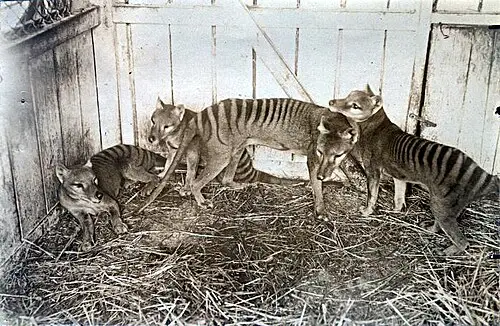
The Thylacine (Tasmanian wolf) was a carnivorous marsupial that lived in Tasmania; it resembled a wolf but had a pouch. It is classified as Extinct (EX) on the IUCN Red List.
🦴 2. Anatomy & Morphology
It had short, dense gray to yellowish-brown fur with 13–19 dark transverse stripes across the rear of its back. Its body structure closely resembled that of wolves, but as a marsupial it had a rear-opening pouch.
🔍 3. Ecology & Behavior
It is known to have eaten only prey it killed itself rather than carrion. It rested in forests and scrub during the day and hunted in the afternoon and evening. Because records of its mating habits are scarce, they are inferred from bounty records.
🇰🇷 4. Connection to Korea
No direct record connecting this species to Korea has been found.
📚 Sources & References
- • IUCN Red List EX (2025) — https://www.iucnredlist.org/species/21866/258672491
- • IUCN Red List category EX — latest assessment at iucnredlist.org
- • mammaldiversity.org — 1000220
- • iucnredlist.org — 258672491
- • wikidata.org — Q123102
- • commons.wikimedia.org — File:Thylacines.jpg
- • animaldiversity.org — Thylacinus cynocephalus
- • Silhouette: PhyloPic — Ivan Iofrida · CC BY 4.0
Recorded dimensions are widely cited representative estimates from public literature and may vary by study or specimen.