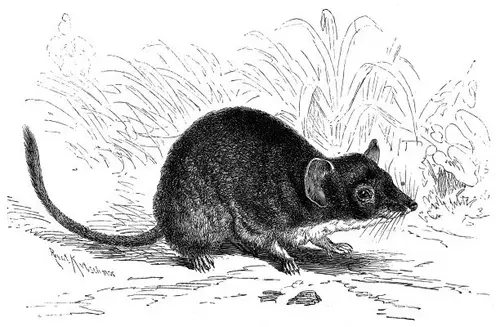
 📸 Photo
Photo: Public domain · Public domain · Wikimedia Commons Source
Yellow-footed Antechinus
Antechinus flavipes (Yellow-footed Antechinus · キアシアンテキヌス)
💡 Everyday Comparisons for Size, Mass & Speed
- 💡 Its maximum weight of 75 g is slightly heavier than a chicken egg (about 60 g), and its maximum body length of 16 cm is slightly shorter than a pencil (about 17.5 cm) (Comparison).
- 💡 It is famous for an unusual mammalian life cycle in which all males die after the 2-week mating season. It also sometimes builds nests inside buildings.
Reference standards: coach bus ~12 m, mid-size car ~4.9 m, compact car ~1 t, basketball hoop 3.05 m, credit card 8.56 cm.
Site-computed relative index from recorded values; not a formal scientific metric.
📖 1. Overview
The yellow-footed antechinus is a small marsupial living in Cape York Peninsula, Victoria, and southeastern and southwestern Australia, commonly seen in dry forests and scrublands.
🦴 2. Anatomy & Morphology
It has a mouse-sized body with a head-and-body length of 90–160 mm and a weight of 20–75 g.
🔍 3. Ecology & Behavior
More diurnal than related species, it forages on the ground, in rock crevices, and in trees for small vertebrates, invertebrates, eggs, and nectar. Mating lasts for 2 weeks, after which all males die. It builds nests of dry eucalyptus leaves in tree hollows, rock crevices, and buildings.
🇰🇷 4. Connection to Korea
No direct record connecting this species to Korea has been found.
📚 Sources & References
- • IUCN Red List LC (2026) — https://www.iucnredlist.org/species/280558427/258650839
- • IUCN Red List category LC — latest assessment at iucnredlist.org
- • mammaldiversity.org — 1000172
- • iucnredlist.org — 258650839
- • wikidata.org — Q194981
- • commons.wikimedia.org — File:Beutelgilbmaus brehm.png
- • brainmuseum.org — index.html
- • Silhouette: PhyloPic — Robbi Bishop-Taylor · CC0 1.0
Recorded dimensions are widely cited representative estimates from public literature and may vary by study or specimen.