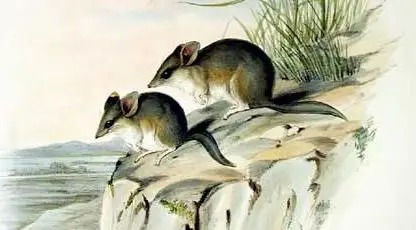
 📸 Photo
Photo: John Gould · Public domain · Wikimedia Commons Source
Fat-tailed Dunnart
Sminthopsis crassicaudata (Fat-tailed Dunnart · オブトスミントプシス)
💡 Everyday Comparisons for Size, Mass & Speed
- 💡 Its average weight of 16 g is similar to two Korean 500-won coins (about 15.4 g), and its maximum body length of 11 cm is shorter than a ballpoint pen (about 14 cm) (Comparison).
- 💡 In colder months, it is known to huddle together with house mice to share body heat and save energy.
Reference standards: coach bus ~12 m, mid-size car ~4.9 m, compact car ~1 t, basketball hoop 3.05 m, credit card 8.56 cm.
Site-computed relative index from recorded values; not a formal scientific metric.
📖 1. Overview
The Fat-tailed Dunnart is a mouse-sized carnivorous marsupial living in Australia that is active at night.
🦴 2. Anatomy & Morphology
It has buff-to-brown fur with dark patches on its ears and head. Its head-and-body length is 64–110 mm.
🔍 3. Ecology & Behavior
It feeds on insects such as grasshoppers, moths, and beetles. After a gestation of 13–16 days, females give birth to up to 10 young per litter, which emerge from the mother's pouch at around 37 days of age.
🇰🇷 4. Connection to Korea
No direct record connecting this species to Korea has been found.
📚 Sources & References
- • IUCN Red List LC (2016) — https://www.iucnredlist.org/species/40541/21948539
- • IUCN Red List category LC — latest assessment at iucnredlist.org
- • mammaldiversity.org — 1000202
- • iucnredlist.org — 21948539
- • wikidata.org — Q194519
- • commons.wikimedia.org — File:Sminthopsis crassicaudata - Gould.jpg
- • animaldiversity.org — Sminthopsis crassicaudata
- • Silhouette: PhyloPic — Sarah Werning · CC BY 3.0
Recorded dimensions are widely cited representative estimates from public literature and may vary by study or specimen.