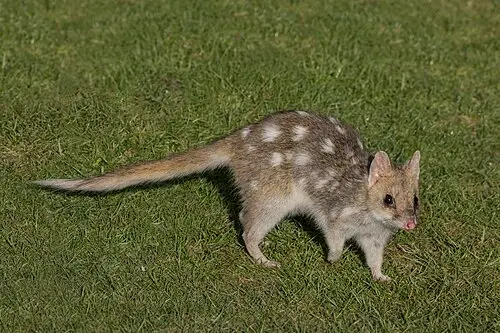
 📸 Photo
Photo: Charles J. Sharp · CC BY-SA 4.0 · Wikimedia Commons Source
Eastern Quoll
Dasyurus viverrinus (Eastern Quoll · フクロネコ)
💡 Everyday Comparisons for Size, Mass & Speed
- 💡 Its maximum weight of 1.55 kg is similar to a 1.5 L bottle of water, and it is about the size of a small cat (Comparison).
- 💡 It clears away carrion and eats crop-damaging mice and insects. Attacks by dogs, vehicle collisions, illegal poison baits, and traps set by poultry keepers are its main causes of death.
Reference standards: coach bus ~12 m, mid-size car ~4.9 m, compact car ~1 t, basketball hoop 3.05 m, credit card 8.56 cm.
Site-computed relative index from recorded values; not a formal scientific metric.
📖 1. Overview
The Eastern Quoll is a carnivorous marsupial the size of a small cat that once lived widely across eastern Australia but now survives almost only in Tasmania. It is listed as Endangered (EN) on the IUCN Red List.
🦴 2. Anatomy & Morphology
Its fur is black, brown, or tan with white spots on the body and sometimes a white tail tip. It has a pink nose and ears, very sharp teeth, and lacks a first toe on the hind foot.
🔍 3. Ecology & Behavior
Hunting at night, it eats mainly insects along with small marsupials, rats, rabbits, carrion, and some plant matter, subduing prey with a bite to the neck. Up to 30 young are born at a time, but only as many as there are teats (6–8) survive in the pouch.
🇰🇷 4. Connection to Korea
No direct record connecting this species to Korea has been found.
📚 Sources & References
- • IUCN Red List EN (2016) — https://www.iucnredlist.org/species/6296/21947190
- • IUCN Red List category EN — latest assessment at iucnredlist.org
- • mammaldiversity.org — 1000152
- • iucnredlist.org — 21947190
- • wikidata.org — Q194516
- • commons.wikimedia.org — File:Eastern quoll (Dasyurus viverrinus) fawn morph Esk vall
- • animaldiversity.org — Dasyurus viverrinus
- • Silhouette: PhyloPic — Kawinwit Kittipalawattanapol · CC0 1.0
Recorded dimensions are widely cited representative estimates from public literature and may vary by study or specimen.