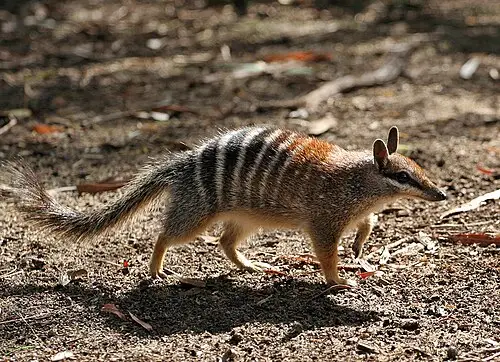
 📸 Photo
Photo: Martybugs at English Wikipedia · CC BY 3.0 · Wikimedia Commons Source
Numbat
Myrmecobius fasciatus (Numbat · フクロアリクイ)
💡 Everyday Comparisons for Size, Mass & Speed
- 💡 A maximum weight of 752 g is lighter than a 1 L carton of milk (about 1 kg), and a maximum body length of 29 cm is similar to the long side of an A4 sheet of paper (29.7 cm) (Comparison).
- 💡 It eats 15,000–20,000 termites a day. Indigenous Australians once called it "walpurti" and hunted it for food, but it is now a protected species.
Reference standards: coach bus ~12 m, mid-size car ~4.9 m, compact car ~1 t, basketball hoop 3.05 m, credit card 8.56 cm.
Site-computed relative index from recorded values; not a formal scientific metric.
📖 1. Overview
The Numbat is a small, slender marsupial that lives in eucalyptus woodlands of southwestern Australia and feeds on termites. It is listed as Near Threatened (NT) on the IUCN Red List.
🦴 2. Anatomy & Morphology
It has a small, flat head with a long, pointed snout. Between 4 and 11 white bands cross the short, stiff reddish-brown fur of its back and rump, and its slender, sticky tongue extends more than 100 mm.
🔍 3. Ecology & Behavior
It eats about 15,000–20,000 termites a day. Because it lacks the strength to break open termite mounds, it is an unusual diurnal marsupial that forages by day when termites are active in shallow galleries, and rests in hollow logs at night.
🇰🇷 4. Connection to Korea
No direct record connecting this species to Korea has been found.
📚 Sources & References
- • IUCN Red List NT (2026) — https://www.iucnredlist.org/species/14222/258675506
- • IUCN Red List category NT — latest assessment at iucnredlist.org
- • mammaldiversity.org — 1000219
- • iucnredlist.org — 258675506
- • wikidata.org — Q242419
- • commons.wikimedia.org — File:Numbat.jpg
- • animaldiversity.org — Myrmecobius fasciatus
- • Silhouette: PhyloPic — Sarah Werning · CC BY 3.0
Recorded dimensions are widely cited representative estimates from public literature and may vary by study or specimen.