 📸 Photo
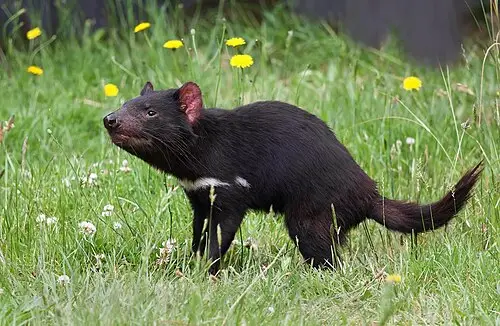
Photo: JJ Harrison ( https://www.jjharrison.com.au/ ) · CC BY-SA 3.0 · Wikimedia Commons Source
Tasmanian Devil
Sarcophilus harrisii (Tasmanian Devil · タスマニアデビル)
💡 Everyday Comparisons for Size, Mass & Speed
- 💡 Its shoulder height of about 30 cm is equal to the long side of an A4 sheet of paper (29.7 cm) (Comparison).
- 💡 Because a contagious facial tumor disease has sharply reduced its numbers, it frequently appears in conservation news.
Reference standards: coach bus ~12 m, mid-size car ~4.9 m, compact car ~1 t, basketball hoop 3.05 m, credit card 8.56 cm.
Site-computed relative index from recorded values; not a formal scientific metric.
📖 1. Overview
The Tasmanian Devil is the largest carnivorous marsupial, found only on the Australian island of Tasmania, where it roams at night in search of food.
🦴 2. Anatomy & Morphology
It has a stocky build and brownish-black fur with white markings on the chest and sides, along with a large head and powerful jaws and molars. It stores fat in its tail.
🔍 3. Ecology & Behavior
Using mainly its sense of smell, it locates carrion and devours even bones and fur, while also eating insects, snakes, and small plants. It mates in March, gives birth after a 21-day gestation in April to usually 2–3 young, and the young grow in the pouch for about 4 months.
🇰🇷 4. Connection to Korea
No direct record connecting this species to Korea has been found.
📚 Sources & References
- • IUCN Red List EN (2008) — https://www.iucnredlist.org/species/40540/10331066
- • IUCN Red List category EN — latest assessment at iucnredlist.org
- • mammaldiversity.org — 1000166
- • iucnredlist.org — 10331066
- • wikidata.org — Q134964
- • commons.wikimedia.org — File:Sarcophilus harrisii taranna.jpg
- • animaldiversity.org — Sarcophilus harrisii
- • Silhouette: PhyloPic — Soledad Miranda-Rottmann · CC BY 3.0
Recorded dimensions are widely cited representative estimates from public literature and may vary by study or specimen.