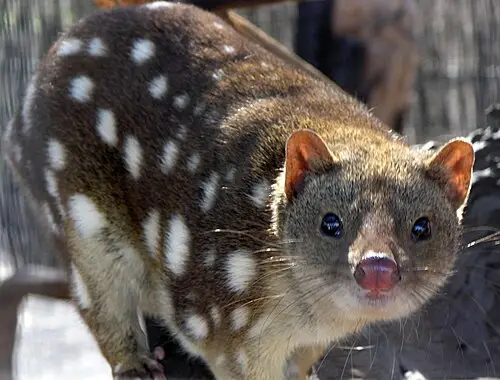
 📸 Photo
Photo: SeanMack at English Wikipedia · CC BY-SA 3.0 · Wikimedia Commons Source
Spotted-tailed Quoll
Dasyurus maculatus (Spotted-tailed Quoll · オオフクロネコ)
💡 Everyday Comparisons for Size, Mass & Speed
- 💡 Its maximum weight of 7 kg is seven-tenths of a 10 kg bag of rice, and its maximum total length of 1.13 m is similar to the height of a lower-grade elementary school child (Comparison).
- 💡 As the largest carnivorous marsupial and largest dasyurid, it preys mainly on mammals such as rabbits and bandicoots.
Reference standards: coach bus ~12 m, mid-size car ~4.9 m, compact car ~1 t, basketball hoop 3.05 m, credit card 8.56 cm.
Site-computed relative index from recorded values; not a formal scientific metric.
📖 1. Overview
The Spotted-tailed Quoll is the largest carnivorous marsupial living in the forests of Australia. It is the only quoll with white spots on its tail as well, and is listed as Near Threatened (NT) on the IUCN Red List.
🦴 2. Anatomy & Morphology
It has distinct white spots across its entire reddish-brown body and tail. Males are larger than females.
🔍 3. Ecology & Behavior
A meat-specializing hunter, it preys on greater gliders, rabbits, bandicoots, and pademelons (small macropods), and also eats insects in summer. Mostly solitary, individuals share communal latrines and dens.
🇰🇷 4. Connection to Korea
No direct record connecting this species to Korea has been found.
📚 Sources & References
- • IUCN Red List NT (2018) — https://www.iucnredlist.org/species/6300/21946847
- • IUCN Red List category NT — latest assessment at iucnredlist.org
- • mammaldiversity.org — 1000150
- • iucnredlist.org — 21946847
- • wikidata.org — Q194526
- • commons.wikimedia.org — File:SpottedQuoll 2005 SeanMcClean.jpg
- • animaldiversity.org — Dasyurus maculatus
- • Silhouette: PhyloPic — Kawinwit Kittipalawattanapol · CC0 1.0
Recorded dimensions are widely cited representative estimates from public literature and may vary by study or specimen.