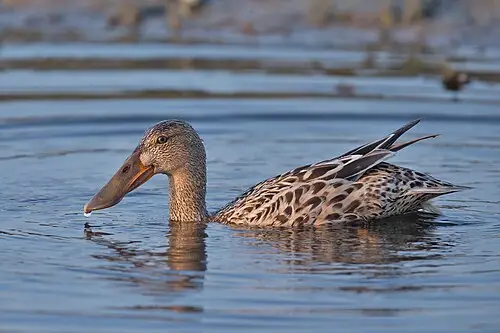
 📸 Photo
Photo: Andreas Trepte · CC BY-SA 2.5 · Wikimedia Commons Source
Northern Shoveler
Spatula clypeata (Northern Shoveler · ハシビロガモ)
💡 Everyday Comparisons for Size, Mass & Speed
- 💡 Its body length of 48 cm is about the distance from an adult's elbow to the fingertips, and its bill alone is about 6.3 cm, slightly longer than the short side of a credit card (about 5.4 cm) (Comparison).
- 💡 Filtering muddy water with its shovel-shaped bill is a hallmark of this bird seen on lakes and wetlands in winter (Smithsonian National Zoo diet description).
Reference standards: coach bus ~12 m, mid-size car ~4.9 m, compact car ~1 t, basketball hoop 3.05 m, credit card 8.56 cm.
Site-computed relative index from recorded values; not a formal scientific metric.
📖 1. Overview
The Northern Shoveler is a dabbling duck with a broad, shovel-like bill. It can be seen year-round in the Americas and Europe, and winters as far south as Africa, India, and Southeast Asia.
🦴 2. Anatomy & Morphology
It is easily recognized by its long, shovel-shaped bill. The male's bill is dark gray while the female's is pale gray with an orange edge, and breeding males have a dark green head with a white and chestnut body. Both sexes show a bright green wing patch in flight.
🔍 3. Ecology & Behavior
Comb-like projections along the edge of its bill allow it to filter tiny crustaceans and seeds from the water, and it also eats aquatic plants such as duckweed along with insects, snails, and tadpoles. Groups sometimes swim together in large circles to stir up bottom mud and draw out crustaceans.
🇰🇷 4. Connection to Korea
It is listed under the name 'Neoljeokburi' (Korean name) in the National List of Species of Korea.
📚 Sources & References
- • IUCN Red List LC (2019) — https://www.iucnredlist.org/species/22680247/153875944
- • IUCN Red List category LC — latest assessment at iucnredlist.org
- • doi.org — avilist.v2026
- • iucnredlist.org — 153875944
- • 국가생물종목록(국립생물자원관) ktsn 120000528781 — https://species.nibr.go.kr/home/mainHome.do?cont_link=009&subMenu=009002&contCd=009002&ktsn=120000528781
- • wikidata.org — Q28106731
- • commons.wikimedia.org — File:Northern Shoveler-Anas clypeata female.jpg
- • nationalzoo.si.edu — northern-shoveler
- • Silhouette: PhyloPic — Andy Wilson · CC0 1.0
Recorded dimensions are widely cited representative estimates from public literature and may vary by study or specimen.