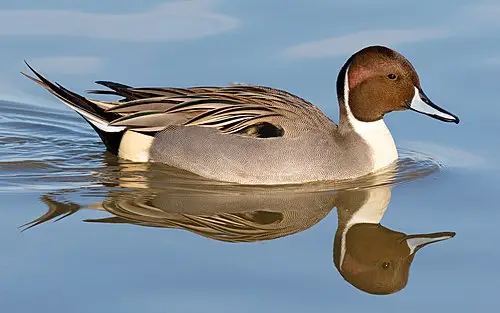
 📸 Photo
Photo: Frank Schulenburg · CC BY-SA 4.0 · Wikimedia Commons Source
Northern Pintail
Anas acuta (Northern Pintail · オナガガモ)
💡 Everyday Comparisons for Size, Mass & Speed
- 💡 Its maximum wingspan of 91 cm is slightly longer than the width of a rice sack, and its maximum weight of 1.36 kg is slightly lighter than one 1.5 L bottle of water (Comparison).
- 💡 In winter, large flocks can be seen on reservoirs, estuaries, and wetlands near rice paddies and fields (National List of Species of Korea).
- 💡 One of the most popular game ducks during duck hunting season in many parts of the world, money spent by hunters supports the economies of towns along migratory flyways (ADW, 'Economic Importance for Humans: Positive').
Reference standards: coach bus ~12 m, mid-size car ~4.9 m, compact car ~1 t, basketball hoop 3.05 m, credit card 8.56 cm.
Site-computed relative index from recorded values; not a formal scientific metric.
📖 1. Overview
The Northern Pintail is a large duck with a long neck and a long, pointed tail that breeds in northern Eurasia and North America and migrates to temperate and tropical regions in winter. In Korea it is a common winter visitor.
🦴 2. Anatomy & Morphology
Males are dark brown from the head to the back of the neck with a white lower neck and breast and very long, pointed central tail feathers. Females are brown overall with a black bill. In flight, the inner wing feathers flash green in males and bronze in females.
🔍 3. Ecology & Behavior
Submerging its head and forebody with its tail tipped up, it feeds on snails, water bugs, and aquatic plant roots, and also eats rice, wheat, barley, and insects in grain fields. Famous for flying long distances in a short time in winter, a bird banded in Canada was recovered in England 9 days later.
🇰🇷 4. Connection to Korea
In the National List of Species of Korea, it is listed as a winter visitor commonly observed in wetlands nationwide during winter.
📚 Sources & References
- • IUCN Red List LC (2019) — https://www.iucnredlist.org/species/22680301/153882797
- • IUCN Red List category LC — latest assessment at iucnredlist.org
- • doi.org — avilist.v2026
- • iucnredlist.org — 153882797
- • 국가생물종목록(국립생물자원관) ktsn 120000001443 — https://species.nibr.go.kr/home/mainHome.do?cont_link=009&subMenu=009002&contCd=009002&ktsn=120000001443
- • wikidata.org — Q25450
- • commons.wikimedia.org — File:Male northern pintail at Llano Seco.jpg
- • animaldiversity.org — Anas acuta
- • nationalzoo.si.edu — northern-pintail
- • species.nibr.go.kr — mainHome.do
- • Silhouette: PhyloPic — Andy Wilson · CC0 1.0
Recorded dimensions are widely cited representative estimates from public literature and may vary by study or specimen.