 📸 Photo
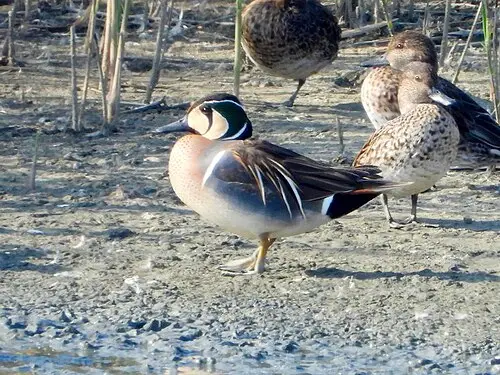
Photo: hengchian · CC BY 4.0 · Wikimedia Commons Source
Baikal Teal
Sibirionetta formosa (Baikal Teal · トモエガモ)
💡 Everyday Comparisons for Size, Mass & Speed
- 💡 Its weight of 437 g is about the weight of seven chicken eggs (Comparison).
- 💡 Because it feeds on grain in fields at night, it can be seen on waters near winter farmlands (ADW diet description).
- 💡 It is hunted for its feathers and meat and is also traded as a pet (ADW 'Economic Importance for Humans: Positive').
Reference standards: coach bus ~12 m, mid-size car ~4.9 m, compact car ~1 t, basketball hoop 3.05 m, credit card 8.56 cm.
Site-computed relative index from recorded values; not a formal scientific metric.
📖 1. Overview
The Baikal Teal is a small duck that breeds in ponds of the Siberian taiga and tundra and winters near southern rivers, lakes, and farmlands. It rests on the water during the day and forages in fields at night.
🦴 2. Anatomy & Morphology
Its body length is 39–43 cm, and average weight is 437 g in males and 431 g in females, showing little difference in size between the sexes.
🔍 3. Ecology & Behavior
It feeds mainly on grains and seeds as well as small aquatic invertebrates such as water snails. It eats algae and aquatic plants in the water by day and forages in farmlands at night. It breeds once in May, laying 4–10 eggs and incubating them for 24–25 days.
🇰🇷 4. Connection to Korea
It is listed under the name 'Gachang-ori' (Korean name) in the National List of Species of Korea.
📚 Sources & References
- • IUCN Red List LC (2025) — https://www.iucnredlist.org/species/22680317/280907776
- • IUCN Red List category LC — latest assessment at iucnredlist.org
- • doi.org — avilist.v2026
- • iucnredlist.org — 280907776
- • 국가생물종목록(국립생물자원관) ktsn 120000528788 — https://species.nibr.go.kr/home/mainHome.do?cont_link=009&subMenu=009002&contCd=009002&ktsn=120000528788
- • wikidata.org — Q27461190
- • commons.wikimedia.org — File:Baikal Teal, Kaohsiung City, Taiwan 1.jpg
- • animaldiversity.org — Anas formosa
- • Silhouette: PhyloPic — Kai Caspar · CC0 1.0 (Related taxon silhouette — Dendrocygna viduata)
Recorded dimensions are widely cited representative estimates from public literature and may vary by study or specimen.