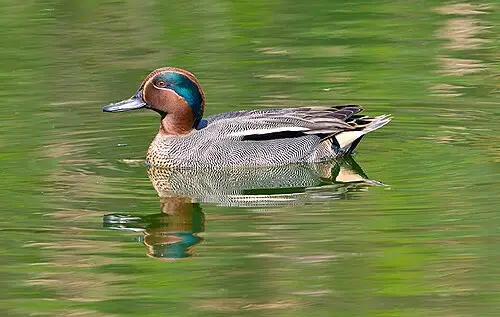
 📸 Photo
Photo: Koshy Koshy from Faridabad, Haryana, India · CC BY 2.0 · Wikimedia Commons Source
Green-winged Teal
Anas crecca (Green-winged Teal · コガモ)
💡 Everyday Comparisons for Size, Mass & Speed
- 💡 Its average weight of 250 g is about the weight of four eggs (Comparison).
- 💡 Because it forages in rice paddies and fields on winter nights, it can be encountered around harvested rice paddies (National List of Species of Korea).
- 💡 In the United States, it is the most hunted duck after the Mallard, with about 1.7 million harvested a year (ADW, 'Economic Importance for Humans: Positive').
Reference standards: coach bus ~12 m, mid-size car ~4.9 m, compact car ~1 t, basketball hoop 3.05 m, credit card 8.56 cm.
Site-computed relative index from recorded values; not a formal scientific metric.
📖 1. Overview
The Green-winged Teal is one of the smallest dabbling ducks in North America and breeds across northern Eurasia. In Korea, it is a common winter visitor arriving from early September (month 9) to spend the winter.
🦴 2. Anatomy & Morphology
It is characterized by glossy green secondary feathers on the inner wing. Males have a reddish-brown head with a dark green patch from the eye to the nape and a distinct white horizontal stripe on the flank. Females are dark brown with black markings.
🔍 3. Ecology & Behavior
An opportunistic forager, it eats insects and larvae, grass seeds, and aquatic plants, and feeds heavily on grains such as rice, barley, and corn in winter. It rests on rivers or reservoirs by day and forages in rice paddies, fields, and wet meadows at night, forming small flocks on its wintering grounds and flying swiftly and erratically.
🇰🇷 4. Connection to Korea
In the National List of Species of Korea, it is listed as a common winter visitor that arrives in early September (month 9) and winters on reservoirs, lakes, rivers, and streams nationwide until late April (month 4).
📚 Sources & References
- • IUCN Red List LC (2020) — https://www.iucnredlist.org/species/22680321/181692388
- • IUCN Red List category LC — latest assessment at iucnredlist.org
- • doi.org — avilist.v2026
- • iucnredlist.org — 181692388
- • 국가생물종목록(국립생물자원관) ktsn 120000001446 — https://species.nibr.go.kr/home/mainHome.do?cont_link=009&subMenu=009002&contCd=009002&ktsn=120000001446
- • wikidata.org — Q25700
- • commons.wikimedia.org — File:Common Teal Male (8602525826).jpg
- • animaldiversity.org — Anas crecca
- • nationalzoo.si.edu — green-winged-teal
- • species.nibr.go.kr — mainHome.do
- • Silhouette: PhyloPic — Andy Wilson · CC0 1.0
Recorded dimensions are widely cited representative estimates from public literature and may vary by study or specimen.