 📸 Photo
Photo: 星外之神 · CC BY-SA 4.0 · Wikimedia Commons Source
Mandarin Duck
Aix galericulata (Mandarin Duck · オシドリ)
🇰🇷 Natural Monument (Korea) «Mandarin Duck»
💡 Everyday Comparisons for Size, Mass & Speed
- 💡 Because males and females are said to always go about together, a devoted married couple is likened to Mandarin Ducks (Korea Heritage Service description).
- 💡 Its weight of 693 g is about 2/3 of one 1 L carton of milk (about 1 kg) (Comparison).
Reference standards: coach bus ~12 m, mid-size car ~4.9 m, compact car ~1 t, basketball hoop 3.05 m, credit card 8.56 cm.
Site-computed relative index from recorded values; not a formal scientific metric.
📖 1. Overview
The Mandarin Duck lives in East Asia, including Korea, China, and Japan, and is well known for the male's ornate plumage.
🦴 2. Anatomy & Morphology
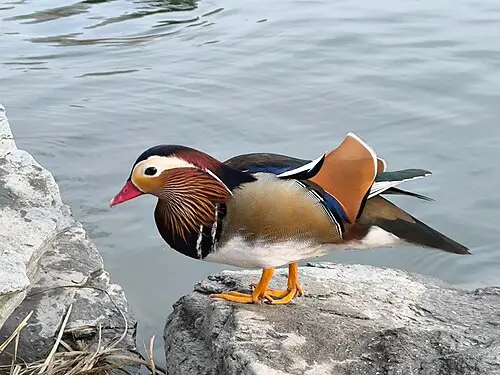
Males have white around the eyes, a chestnut crest and upper breast, a bluish-green back, and raised orange fan-shaped wing feathers (sails). Females have a brownish-gray body with white spots.
🔍 3. Ecology & Behavior
It eats grass seeds, tree fruits, snails, and freshwater fish, and nests mainly in tree cavities of broadleaf trees, laying 7–12 eggs that hatch in 28–30 days.
🇰🇷 4. Connection to Korea
It was designated as a Natural Monument (Korea) on November 16, 1982 (1982-11-16), and spends the winter in flocks on reservoirs, lakes, marshes, and streams.
📚 Sources & References
- • IUCN Red List LC (2018) — https://www.iucnredlist.org/species/22680107/131911544
- • 천연기념물 «원앙» — 국가생물종목록(국립생물자원관) ktsn 120000001433 — https://species.nibr.go.kr/home/mainHome.do?cont_link=009&subMenu=009002&contCd=009002&ktsn=120000001433
- • IUCN Red List category LC — latest assessment at iucnredlist.org
- • Korean protection status: Natural Monument (Korea) «Mandarin Duck»
- • doi.org — avilist.v2026
- • iucnredlist.org — 131911544
- • 국가생물종목록(국립생물자원관) ktsn 120000001433 — https://species.nibr.go.kr/home/mainHome.do?cont_link=009&subMenu=009002&contCd=009002&ktsn=120000001433
- • heritage.go.kr — culSelectDetail.do
- • wikidata.org — Q200339
- • commons.wikimedia.org — File:Mandarin ducks by the Weiming Lake of Peking University
- • heritage.go.kr — cul 1369903270000.html
- • animaldiversity.org — Aix galericulata
- • species.nibr.go.kr — general-search
- • Silhouette: PhyloPic — Andy Wilson · CC0 1.0
Recorded dimensions are widely cited representative estimates from public literature and may vary by study or specimen.