 📸 Photo
Photo: Rolf Dietrich Brecher from Germany · CC BY 2.0 · Wikimedia Commons Source
Mallard
Anas platyrhynchos (Mallard · マガモ)
💡 Everyday Comparisons for Size, Mass & Speed
- 💡 Its average weight of 1,082 g is slightly heavier than a 1 kg bag of sugar, and its body length of 59 cm is about the length of an adult's arm (Comparison).
- 💡 It is the easiest duck to see on lakes, streams, and near rice paddies in winter, flying to fields after sunset to eat fallen grain (National List of Species of Korea).
- 💡 The familiar 'quack-quack' sound we associate with ducks is the call a female Mallard makes to gather her ducklings (ADW behavior account).
Reference standards: coach bus ~12 m, mid-size car ~4.9 m, compact car ~1 t, basketball hoop 3.05 m, credit card 8.56 cm.
Site-computed relative index from recorded values; not a formal scientific metric.
📖 1. Overview
The Mallard is the world's best-known waterfowl and lives widely across the boreal and temperate zones of Eurasia and North America. In Korea, it is the most numerous of the ducks that visit in winter.
🦴 2. Anatomy & Morphology
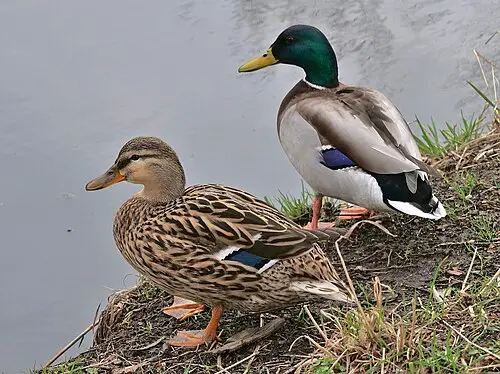
Males have a bright yellow bill, a metallic green head, a narrow white neck ring, and curled black tail feathers. Females are brown overall with dark brown streaks, and both sexes have an iridescent blue speculum on the wing.
🔍 3. Ecology & Behavior
It eats a wide variety of foods including plants, insects, earthworms, and snails, and also gleans grain from crops. Resting in flocks on the water by day, it flies to farmlands and marshes after sunset to forage. It usually lays 6–12 eggs in a nest on the ground.
🇰🇷 4. Connection to Korea
In the National List of Species of Korea, it is listed as a representative winter visitor and the most numerous duck species visiting Korea in winter, with some also breeding in certain regions in spring.
📚 Sources & References
- • IUCN Red List LC (2025) — https://www.iucnredlist.org/species/22680186/281835571
- • IUCN Red List category LC — latest assessment at iucnredlist.org
- • doi.org — avilist.v2026
- • iucnredlist.org — 281835571
- • 국가생물종목록(국립생물자원관) ktsn 120000001440 — https://species.nibr.go.kr/home/mainHome.do?cont_link=009&subMenu=009002&contCd=009002&ktsn=120000001440
- • wikidata.org — Q25348
- • commons.wikimedia.org — File:Anas platyrhynchos (mixed pair) (32428014687).jpg
- • species.nibr.go.kr — mainHome.do
- • animaldiversity.org — Anas platyrhynchos
- • Silhouette: PhyloPic — Andy Wilson · CC0 1.0
Recorded dimensions are widely cited representative estimates from public literature and may vary by study or specimen.