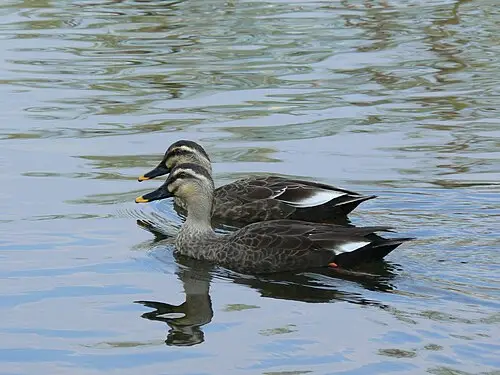
 📸 Photo
Photo: Kuribo · CC BY-SA 2.0 · Wikimedia Commons Source
Eastern Spot-billed Duck
Anas zonorhyncha (Eastern Spot-billed Duck · カルガモ)
💡 Everyday Comparisons for Size, Mass & Speed
- 💡 Its maximum total length of 64.5 cm is about 2/3 of a 1 m ruler, and its maximum weight of 1,156 g is just over half of one 2 L bottle of water (about 2 kg) (Comparison).
- 💡 In rice paddies, it spends much longer foraging at night than during the day: a study in Japan found it spent 67% of its time foraging by day and 94% at night.
- 💡 Its call sounds like the 'quack-quack' of a Mallard, but is said to carry farther.
Reference standards: coach bus ~12 m, mid-size car ~4.9 m, compact car ~1 t, basketball hoop 3.05 m, credit card 8.56 cm.
Site-computed relative index from recorded values; not a formal scientific metric.
📖 1. Overview
The Eastern Spot-billed Duck lives by lowland waters such as lakes, rice paddies, and rivers. Japanese sources note that it breeds across almost all of Japan and lives year-round from Honshu southward, with an eye-catching orange bill tip and legs.
🦴 2. Anatomy & Morphology
Its upperparts from head to tail are dark brown, its breast is buff-brown, and its dark brown belly is densely spotted. It has a creamy yellow eyebrow stripe and a metallic dark blue wing speculum; males and females look alike, except the upper- and undertail coverts are black in males and brown-edged in females.
🔍 3. Ecology & Behavior
It eats seeds and leaves of various plants including rice, filtering food from the water or upending to feed. From late April to July (months 4–7), it builds a saucer-shaped nest in waterside grass or reedbeds and lays 10–14 eggs per clutch, which the female incubates for 26–28 days.
🇰🇷 4. Connection to Korea
It is listed in the National List of Species of Korea (National Institute of Biological Resources (NIBR)) under the Korean name "huinppyam-geomdung-ori" (Anas zonorhyncha).
📚 Sources & References
- • IUCN Red List LC (2018) — https://www.iucnredlist.org/species/22736042/132303839
- • IUCN Red List category LC — latest assessment at iucnredlist.org
- • doi.org — avilist.v2026
- • iucnredlist.org — 132303839
- • 국가생물종목록(국립생물자원관) ktsn 120000154877 — https://species.nibr.go.kr/home/mainHome.do?cont_link=009&subMenu=009002&contCd=009002&ktsn=120000154877
- • wikidata.org — Q1268169
- • commons.wikimedia.org — File:Spot-billed Duck.jpg
- • bird-research.jp — karugamo.pdf
- • species.nibr.go.kr — mainHome.do
- • Silhouette: PhyloPic — Andy Wilson · CC0 1.0 (Congeneric silhouette — Anas platyrhynchos)
Recorded dimensions are widely cited representative estimates from public literature and may vary by study or specimen.