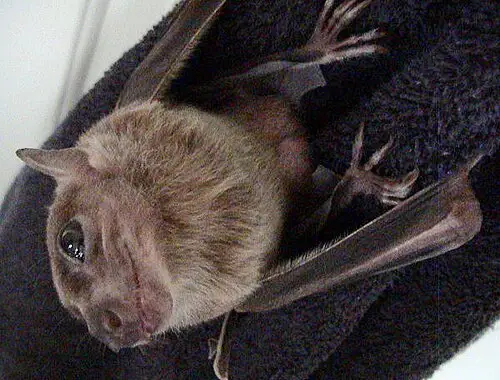
 📸 Photo
Photo: The original uploader was Dawson at English Wikipedia . · CC BY-SA 2.5 · Wikimedia Commons Source
Egyptian Rousette
Rousettus aegyptiacus (Egyptian Rousette · エジプトルーセットオオコウモリ)
💡 Everyday Comparisons for Size, Mass & Speed
- 💡 By pollinating flowers and dispersing seeds of commercial fruit trees, it helps fruit farming.
- 💡 Eating 50–150% of its body weight (up to 170 g) in a night comes to 85–255 g, about half an apple to a whole apple (Comparison).
- 💡 Its wingspan of 60 cm equals the length of a standard 60 cm ruler (Comparison).
Reference standards: coach bus ~12 m, mid-size car ~4.9 m, compact car ~1 t, basketball hoop 3.05 m, credit card 8.56 cm.
Site-computed relative index from recorded values; not a formal scientific metric.
📖 1. Overview
The Egyptian Rousette is a medium-sized fruit bat that forms large colonies in caves across Africa and the Middle East.
🦴 2. Anatomy & Morphology
Its back is dark brown to gray, its belly is paler, and a pale yellow to orange fur collar is often visible around the neck. Its ears are about the length of its muzzle with blunt tips, and males have stiff hairs on the throat.
🔍 3. Ecology & Behavior
It eats the pulp and juice of very ripe fruit and spits out the seeds after chewing, consuming 50–150% of its body weight in fruit in a single night. Colonies range from 20–40 up to 9,000 individuals, and females give birth to a single pup at a time and may breed twice a year.
🇰🇷 4. Connection to Korea
No direct record connecting this species to Korea has been found.
📚 Sources & References
- • IUCN Red List LC (2016) — https://www.iucnredlist.org/species/29730/22043105
- • IUCN Red List category LC — latest assessment at iucnredlist.org
- • mammaldiversity.org — 1004539
- • iucnredlist.org — 22043105
- • wikidata.org — Q754983
- • commons.wikimedia.org — File:Rousettus egypticus.jpg
- • animaldiversity.org — Rousettus aegyptiacus
- • Silhouette: PhyloPic — Steven Traver · CC0 1.0
Recorded dimensions are widely cited representative estimates from public literature and may vary by study or specimen.