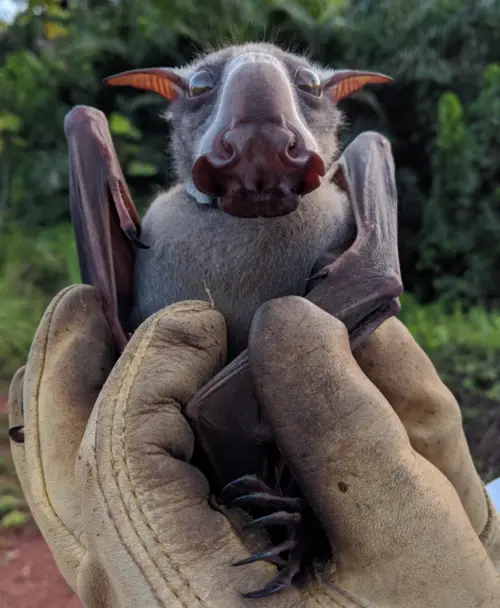
 📸 Photo
Photo: Sarah H. Olson, Gerard Bounga, Alain Ondzie, Trent Bushmaker, Stephanie N. Seifert, Eeva Kuisma, Dylan W. Taylor, Vincent J. Munster, Chris Walzer · CC0 · Wikimedia Commons Source
Hammer-headed Fruit Bat
Hypsignathus monstrosus (Hammer-headed Fruit Bat · ウマヅラコウモリ)
💡 Everyday Comparisons for Size, Mass & Speed
- 💡 People hunt it for food.
- 💡 A male's maximum wingspan of about 1 m is more than half the arm span of an adult human (about 1.7 m) (Comparison).
- 💡 Its diet includes fruits commonly seen in markets, such as mangoes, bananas, and guavas.
Reference standards: coach bus ~12 m, mid-size car ~4.9 m, compact car ~1 t, basketball hoop 3.05 m, credit card 8.56 cm.
Site-computed relative index from recorded values; not a formal scientific metric.
📖 1. Overview
The Hammer-headed Fruit Bat is the largest bat in Africa, and males have a large, square, hammer-like head.
🦴 2. Anatomy & Morphology
Males have an enlarged snout and larynx, a square head, pendulous lips, and wart-like folds around the nose. Females are about half the size of males.
🔍 3. Ecology & Behavior
Active at night, it feeds mainly on figs and also eats mangoes, bananas, and guavas. It uses a lek mating system in which males line up 10 m apart along streamside tree branches, calling with honking sounds and flapping their wings to attract females.
🇰🇷 4. Connection to Korea
No direct record connecting this species to Korea has been found.
📚 Sources & References
- • IUCN Red List LC (2016) — https://www.iucnredlist.org/species/10734/115098825
- • IUCN Red List category LC — latest assessment at iucnredlist.org
- • mammaldiversity.org — 1004529
- • iucnredlist.org — 115098825
- • wikidata.org — Q304912
- • commons.wikimedia.org — File:Hypsignathus monstrosus.png
- • animaldiversity.org — Hypsignathus monstrosus
- • Silhouette: PhyloPic — Margot Michaud · CC0 1.0 (Related taxon silhouette — Pteropus medius)
Recorded dimensions are widely cited representative estimates from public literature and may vary by study or specimen.