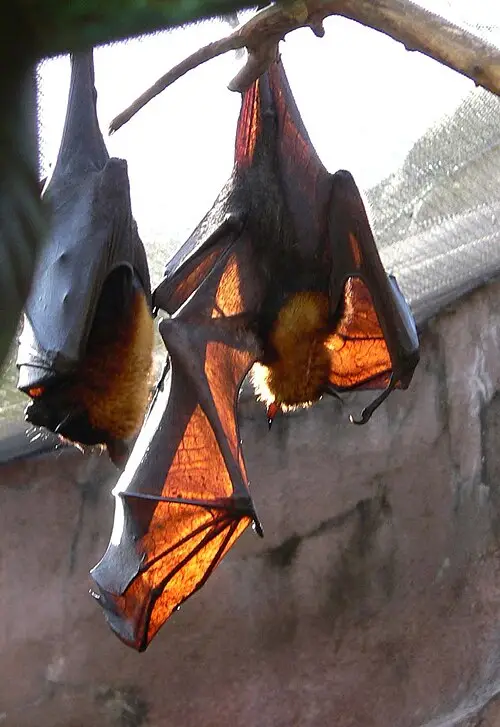
 📸 Photo
Photo: user:Raul654 · CC BY-SA 3.0 · Wikimedia Commons Source
Large Flying Fox
Pteropus vampyrus (Large Flying Fox · ジャワオオコウモリ)
💡 Everyday Comparisons for Size, Mass & Speed
- 💡 By pollinating flowers and dispersing seeds of tropical fruits such as bananas, mangoes, coconuts, durians, and figs, it is closely tied to the fruits people eat.
- 💡 Its wingspan of about 1.5 m is longer than a baseball bat (up to about 1.07 m) (Comparison).
Reference standards: coach bus ~12 m, mid-size car ~4.9 m, compact car ~1 t, basketball hoop 3.05 m, credit card 8.56 cm.
Site-computed relative index from recorded values; not a formal scientific metric.
📖 1. Overview
The Large Flying Fox is one of the largest bats in the world and inhabits coastal forests across mainland and island Southeast Asia.
🦴 2. Anatomy & Morphology
Its body is dark brown to black with yellowish-brown to orange-toned fur around the shoulders. Its ears are long and pointed, and its forearm length reaches 175–230 mm.
🔍 3. Ecology & Behavior
It feeds on fruit, flowers, nectar, and pollen, flying higher than 100 m at dusk and traveling up to 50 km in a night to forage. Females give birth to one young each year, which nurses for 2–3 months.
🇰🇷 4. Connection to Korea
No direct record connecting this species to Korea has been found.
📚 Sources & References
- • IUCN Red List EN (2022) — https://www.iucnredlist.org/species/18766/22088824
- • IUCN Red List category EN — latest assessment at iucnredlist.org
- • mammaldiversity.org — 1004507
- • iucnredlist.org — 22088824
- • wikidata.org — Q649684
- • commons.wikimedia.org — File:Pteropus vampyrus1.jpg
- • tb.plazi.org — 03AD87FAFFA0F64F8CB73E59F67DFE30
- • animaldiversity.org — Pteropus vampyrus
- • Silhouette: PhyloPic — Margot Michaud · CC0 1.0 (Congeneric silhouette — Pteropus medius)
Recorded dimensions are widely cited representative estimates from public literature and may vary by study or specimen.