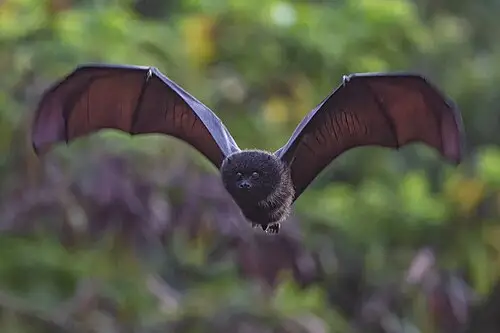
 📸 Photo
Photo: 松井 淳(naturalist67279) · CC0 · Wikimedia Commons Source
Bonin Flying Fox
Pteropus pselaphon (Bonin Flying Fox · オガサワラオオコウモリ)
💡 Everyday Comparisons for Size, Mass & Speed
- 💡 Its maximum forearm length of 14.5 cm is shorter than a new pencil (about 17.5 cm) (Comparison).
- 💡 Its maximum weight of 616 g is slightly heavier than a 500 mL bottle of water (Comparison).
- 💡 Dying after getting caught in agricultural nets while feeding on orchard fruit is one of its main threats.
Reference standards: coach bus ~12 m, mid-size car ~4.9 m, compact car ~1 t, basketball hoop 3.05 m, credit card 8.56 cm.
Site-computed relative index from recorded values; not a formal scientific metric.
📖 1. Overview
The Bonin Flying Fox is a large fruit bat living in subtropical forests, with a very small total population of about 300–400 individuals, and is listed as Endangered (EN) by the IUCN.
🦴 2. Anatomy & Morphology
It lacks a tail and measures 23–29 mm in ear length, 42–50 mm in hindfoot length, and 131–145 mm in forearm length. Its body fur is long and dense, dark brown to blackish-brown like a fur seal, and its wing membranes are jet black.
🔍 3. Ecology & Behavior
Active at night, it eats 31 species of fruit, especially favoring the endemic Pandanus boninensis, as well as flowers, fern leaves, and orchard fruits. In winter, 6–20 individuals huddle into a ball to keep warm, and entanglement in farm nets along with cats and dogs pose threats.
🇰🇷 4. Connection to Korea
No direct record connecting this species to Korea has been found.
📚 Sources & References
- • IUCN Red List EN (2017) — https://www.iucnredlist.org/species/18752/22085351
- • IUCN Red List category EN — latest assessment at iucnredlist.org
- • mammaldiversity.org — 1004491
- • iucnredlist.org — 22085351
- • wikidata.org — Q557468
- • commons.wikimedia.org — File:Pteropus pselaphon naturalist67279.jpg
- • publication.plazi.org — 03AD87FAFFA6F64889B43C89F729F6A7
- • Silhouette: PhyloPic — Margot Michaud · CC0 1.0 (Congeneric silhouette — Pteropus medius)
Recorded dimensions are widely cited representative estimates from public literature and may vary by study or specimen.