 📸 Photo
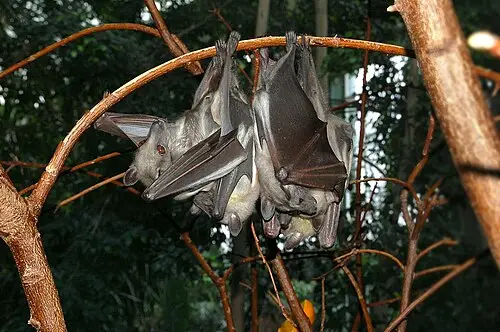
Photo: Fritz Geller-Grimm · CC BY-SA 2.5 · Wikimedia Commons Source
African Straw-colored Fruit Bat
Eidolon helvum (African Straw-colored Fruit Bat · ストローオオコウモリ)
💡 Everyday Comparisons for Size, Mass & Speed
- 💡 In some regions it is an important food source for people.
- 💡 The fruits it eats include dates, mangoes, avocados, figs, and passion fruit, linking it to familiar market fruits.
- 💡 Its maximum weight of 350 g is similar to one canned drink (about 355 g) (Comparison).
Reference standards: coach bus ~12 m, mid-size car ~4.9 m, compact car ~1 t, basketball hoop 3.05 m, credit card 8.56 cm.
Site-computed relative index from recorded values; not a formal scientific metric.
📖 1. Overview
The African Straw-colored Fruit Bat is a large African fruit bat that roosts in huge colonies and also visits areas near farms and cities.
🦴 2. Anatomy & Morphology
Its neck and back are straw-colored while its belly is dull brown to gray, and its head is large and pointed. Its large, narrow wings allow it to fly long distances while saving energy.
🔍 3. Ecology & Behavior
At night it flies out in small groups to forests or plantations, sucking the juice from fruit and spitting out the pulp, with a colony foraging range of about 30 km. Mating occurs in April–June, gestation lasts 9 months (embryo development takes 4 months), and a single young is born in February–March.
🇰🇷 4. Connection to Korea
No direct record connecting this species to Korea has been found.
📚 Sources & References
- • IUCN Red List NT (2020) — https://www.iucnredlist.org/species/7084/22028026
- • IUCN Red List category NT — latest assessment at iucnredlist.org
- • mammaldiversity.org — 1004389
- • iucnredlist.org — 22028026
- • wikidata.org — Q33108
- • commons.wikimedia.org — File:Eidolon helvum fg01.JPG
- • animaldiversity.org — Eidolon helvum
- • Silhouette: PhyloPic — Margot Michaud · CC0 1.0 (Related taxon silhouette — Pteropus medius)
Recorded dimensions are widely cited representative estimates from public literature and may vary by study or specimen.