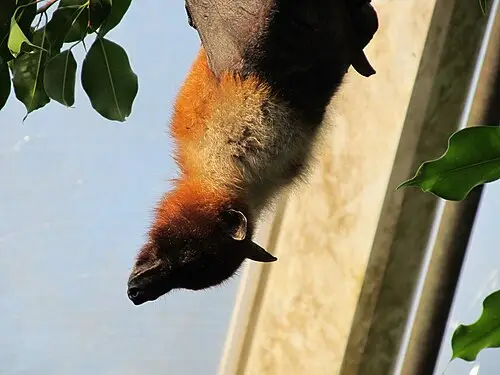
 📸 Photo
Photo: KCZooFan · CC BY-SA 2.0 · Wikimedia Commons Source
Ryukyu Flying Fox
Pteropus dasymallus (Ryukyu Flying Fox · クビワオオコウモリ)
💡 Everyday Comparisons for Size, Mass & Speed
- 💡 By pollinating flowers and dispersing seeds, it benefits timber trees, food crops, and medicinal plants.
- 💡 Its average weight of 435 g is similar to a soccer ball (about 430 g) (Comparison).
- 💡 Because it is especially fond of figs, it depends on fruit-bearing forests.
Reference standards: coach bus ~12 m, mid-size car ~4.9 m, compact car ~1 t, basketball hoop 3.05 m, credit card 8.56 cm.
Site-computed relative index from recorded values; not a formal scientific metric.
📖 1. Overview
The Ryukyu Flying Fox is a large fruit bat living in the island forests of southwestern Japan, roosting in trees during the day.
🦴 2. Anatomy & Morphology
As a megabat, it lacks a tragus and noseleaf, and its teeth are adapted for eating fruit. There are 5 subspecies, and the Daito subspecies has brown wings and a yellow belly and back.
🔍 3. Ecology & Behavior
It feeds mostly on fruit—especially figs—along with flowers and leaves, and also eats insects in summer and autumn. A study on Kuchinoerabu Island found that it ate 17 species of fruit, 9 species of leaves, 5 species of flowers, 8 species of insects, and bark, giving it the most diverse diet studied among megabats.
🇰🇷 4. Connection to Korea
No direct record connecting this species to Korea has been found.
📚 Sources & References
- • IUCN Red List VU (2017) — https://www.iucnredlist.org/species/18722/22080614
- • IUCN Red List category VU — latest assessment at iucnredlist.org
- • mammaldiversity.org — 1004461
- • iucnredlist.org — 22080614
- • wikidata.org — Q575969
- • commons.wikimedia.org — File:Ryukyu Flying Fox 1.jpg
- • animaldiversity.org — Pteropus dasymallus
- • Silhouette: PhyloPic — Margot Michaud · CC0 1.0 (Congeneric silhouette — Pteropus medius)
Recorded dimensions are widely cited representative estimates from public literature and may vary by study or specimen.