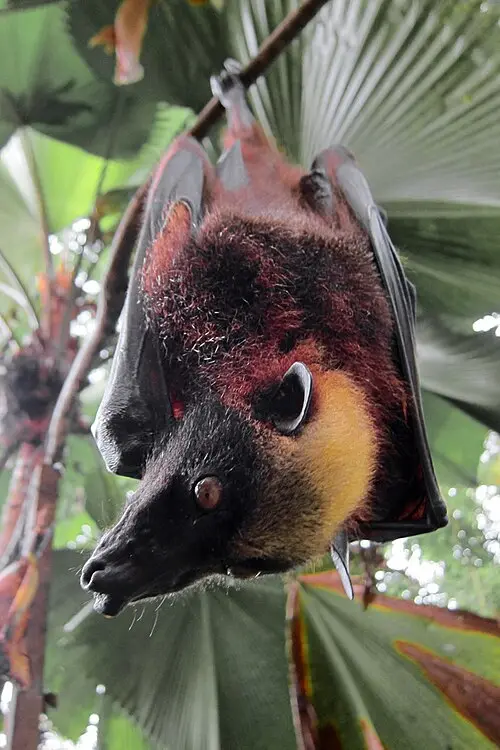
 📸 Photo
Photo: Gregg Yan · CC BY-SA 3.0 · Wikimedia Commons Source
Golden-capped Flying Fox
Acerodon jubatus (Golden-capped Flying Fox · フィリピンオオコウモリ)
💡 Everyday Comparisons for Size, Mass & Speed
- 💡 A maximum wingspan of 1.7 m is similar to an adult human's height (Comparison).
- 💡 Large roosting sites are used as tourist attractions, but hunting and live capture for trade have contributed to its endangered status.
- 💡 A maximum weight of 1.2 kg is slightly heavier than a 1 L carton of milk (about 1 kg) (Comparison).
Reference standards: coach bus ~12 m, mid-size car ~4.9 m, compact car ~1 t, basketball hoop 3.05 m, credit card 8.56 cm.
Site-computed relative index from recorded values; not a formal scientific metric.
📖 1. Overview
The golden-capped flying fox is a very large fruit bat with a wingspan exceeding 1.5 m that roosts in mature lowland forests.
🦴 2. Anatomy & Morphology
It has large, bright eyes and pointed ears about as long as its muzzle. The body fur is short and smooth, dark brown to black on the forehead and sides of the head, and there is a claw on the second digit of each wing.
🔍 3. Ecology & Behavior
Figs are its staple food, with fig seeds making up 41% of seeds in its droppings, and it also chews leaves to swallow only the juice. It leaves its roost at dusk to fly up to 16 km to feeding grounds, and females give birth to one young at a time in April–May (months 4–5).
🇰🇷 4. Connection to Korea
No direct record connecting this species to Korea has been found.
📚 Sources & References
- • IUCN Red List EN (2016) — https://www.iucnredlist.org/species/139/21988328
- • IUCN Red List category EN — latest assessment at iucnredlist.org
- • mammaldiversity.org — 1004444
- • iucnredlist.org — 21988328
- • wikidata.org — Q775576
- • commons.wikimedia.org — File:Acerodon jubatus by Gregg Yan.jpg
- • animaldiversity.org — Acerodon jubatus
- • Silhouette: PhyloPic — Margot Michaud · CC0 1.0 (Related taxon silhouette — Pteropus medius)
Recorded dimensions are widely cited representative estimates from public literature and may vary by study or specimen.