 📸 Photo
Photo: Justin Welbergen · CC BY 3.0 · Wikimedia Commons Source
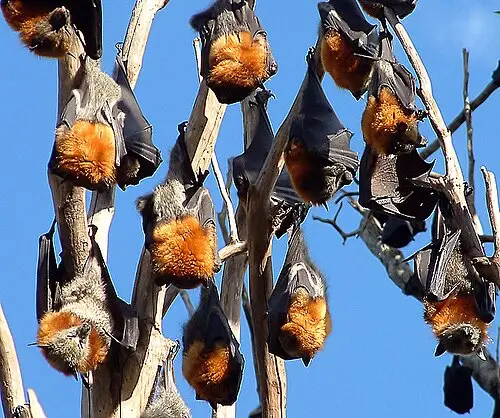
Gray-headed Flying Fox
Pteropus poliocephalus (Gray-headed Flying Fox · Gray-headed Flying Fox)
💡 Everyday Comparisons for Size, Mass & Speed
- 💡 By pollinating eucalyptus flowers and dispersing seeds, it plays an important role in the regeneration of Australian forests.
- 💡 It also forages in suburban gardens and fruit orchards where people live.
- 💡 Its average weight of 677 g is about 2/3 of a 1 L carton of milk (about 1 kg) (Comparison).
Reference standards: coach bus ~12 m, mid-size car ~4.9 m, compact car ~1 t, basketball hoop 3.05 m, credit card 8.56 cm.
Site-computed relative index from recorded values; not a formal scientific metric.
📖 1. Overview
The Gray-headed Flying Fox is the largest bat in Australia, with a fox-like face and roosting camps where thousands gather.
🦴 2. Anatomy & Morphology
It has no tail, bears claws on its first and second digits, and navigates with its large eyes because it cannot echolocate. Its body is dark gray, its head fur is a lighter gray, and a reddish-brown collar of fur rings its neck.
🔍 3. Ecology & Behavior
At night it flies up to 50 km in search of food, though usually within 15 km, eating fruit, pollen, nectar, and bark, with a strong preference for eucalyptus blossoms. It mates in April–May and gives birth to a single young in October–November after about 6 months of gestation.
🇰🇷 4. Connection to Korea
No direct record connecting this species to Korea has been found.
📚 Sources & References
- • IUCN Red List VU (2021) — https://www.iucnredlist.org/species/18751/22085511
- • IUCN Red List category VU — latest assessment at iucnredlist.org
- • mammaldiversity.org — 1004490
- • iucnredlist.org — 22085511
- • wikidata.org — Q551930
- • commons.wikimedia.org — File:P. poliocephalus.jpg
- • animaldiversity.org — Pteropus poliocephalus
- • Silhouette: PhyloPic — Margot Michaud · CC0 1.0
Recorded dimensions are widely cited representative estimates from public literature and may vary by study or specimen.