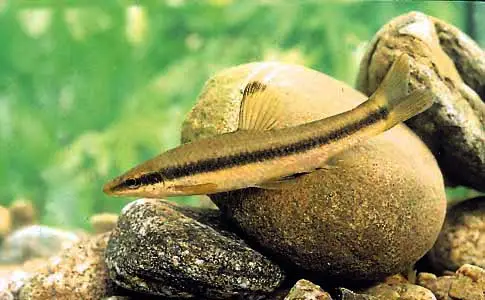
 📸 Photo
Photo: Kebikids1234 · CC BY-SA 4.0 · Wikimedia Commons Source
Slender shinner
Pseudopungtungia tenuicorpus (Slender shinner · Slender shinner)
Not Evaluated (NE) on the IUCN Red List yet.
🇰🇷 Class II endangered wildlife (Korea)
💡 Everyday Comparisons for Size, Mass & Speed
- 💡 Its maximum total length of 10 cm is 1.4 cm longer than the width of a credit card (about 8.6 cm) (Comparison).
- 💡 Because it has the habit of depositing its eggs in the spawning nests of the Korean perch, it lives alongside them in clear riffles (National List of Species of Korea).
- 💡 It is an endangered wildlife species living only in parts of the middle and upper Han and Imjin Rivers (National Institute of Ecology).
Reference standards: coach bus ~12 m, mid-size car ~4.9 m, compact car ~1 t, basketball hoop 3.05 m, credit card 8.56 cm.
📖 1. Overview
The slender shinner is a Korean endemic freshwater fish living only in the Han and Imjin Rivers, designated as Endangered Wildlife Class II. Its body is very slender and elongated.
🦴 2. Anatomy & Morphology
The body is slender and elongated, and the snout is pointed but more rounded at the tip than in Pungtungia herzi. The small mouth lies underneath the snout with 1 pair of short barbels, and a broad blackish-brown stripe runs along the side from snout tip to tail.
🔍 3. Ecology & Behavior
It feeds mainly on aquatic insects. From May to July it lays eggs beneath narrow rock crevices or deposits them in the spawning nests of the Korean perch (Coreoperca herzi). Juveniles live along shallow margins, while individuals 3 years and older live beside deep boulders in pools.
🇰🇷 4. Connection to Korea
It is an Endangered Wildlife Class II species and a Korean endemic restricted to parts of the middle and upper Han and Imjin Rivers. Its numbers are declining due to habitat loss from water pollution, river channel works, aggregate extraction, and dam construction.
📚 Sources & References
- • 멸종위기 야생생물 Ⅱ급 — 국가생물종목록(국립생물자원관) ktsn 120000057604 — https://species.nibr.go.kr/home/mainHome.do?cont_link=009&subMenu=009002&contCd=009002&ktsn=120000057604
- • IUCN Red List: not evaluated (NE) — cross-checked with the Wikidata conservation-status entry
- • Korean protection status: Class II endangered wildlife (Korea)
- • catalogueoflife.org — 4P98N
- • 국가생물종목록(국립생물자원관) ktsn 120000057604 — https://species.nibr.go.kr/home/mainHome.do?cont_link=009&subMenu=009002&contCd=009002&ktsn=120000057604
- • wikidata.org — Q5915281
- • fishbase.se — Pseudopungtungia-tenuicorpus.html
- • species.nibr.go.kr — mainHome.do
- • nie.re.kr — view.do
- • Silhouette: PhyloPic — Carlos Cano-Barbacil · CC0 1.0 (Related taxon silhouette — Luciobarbus graellsii)
Recorded dimensions are widely cited representative estimates from public literature and may vary by study or specimen.