 📸 Photo
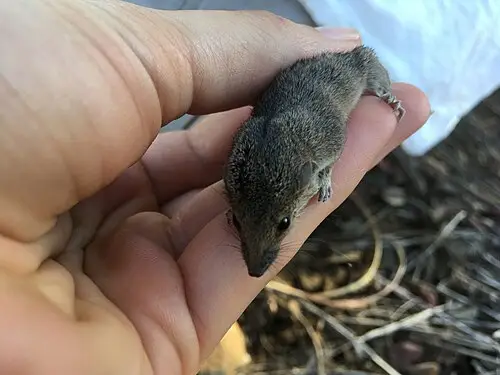
Photo: Donna Belder · CC BY 4.0 · Wikimedia Commons Source
Little Planigale
Planigale ingrami (Little Planigale · オナガプラニガーレ)
💡 Everyday Comparisons for Size, Mass & Speed
- 💡 Its average weight of 4.3 g is just over half of one Korean 500-won coin (7.7 g), and its body length of 6.5 cm is about 2.5 times the coin's diameter (about 2.65 cm) (Comparison).
- 💡 It has been observed leaving the head and wings of insects and eating only the fleshy parts.
Reference standards: coach bus ~12 m, mid-size car ~4.9 m, compact car ~1 t, basketball hoop 3.05 m, credit card 8.56 cm.
Site-computed relative index from recorded values; not a formal scientific metric.
📖 1. Overview
The Little Planigale is the smallest living marsupial and inhabits the grasslands of northern Australia.
🦴 2. Anatomy & Morphology
It weighs 4.2–4.3 g and measures 55–65 mm in length. Mouse-like with a flat head and pointed muzzle, it has a hairless tail that makes up nearly half of its total length.
🔍 3. Ecology & Behavior
During the dry season, it hides in soil cracks to hunt insects and small animals. It hunts at night, feeding mainly on grasshoppers and crickets, and conserves energy by entering daily torpor for 2–4 hours a day.
🇰🇷 4. Connection to Korea
No direct record connecting this species to Korea has been found.
📚 Sources & References
- • IUCN Red List LC (2025) — https://www.iucnredlist.org/species/40534/258652315
- • IUCN Red List category LC — latest assessment at iucnredlist.org
- • mammaldiversity.org — 1000191
- • iucnredlist.org — 258652315
- • wikidata.org — Q194198
- • commons.wikimedia.org — File:Long-tailed planigale2.jpg
- • animaldiversity.org — Planigale ingrami
- • Silhouette: PhyloPic — Rachel T Mason · CC0 1.0 (Related taxon silhouette — Sminthopsis murina)
Recorded dimensions are widely cited representative estimates from public literature and may vary by study or specimen.