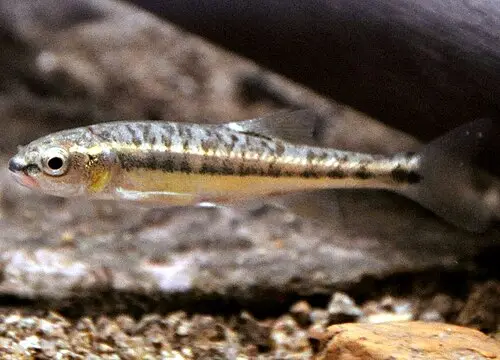
 📸 Photo
Photo: Adrien Pinot · CC BY-SA 3.0 · Wikimedia Commons Source
Eurasian minnow
Phoxinus phoxinus (Eurasian minnow · ヒメハヤ)
🇰🇷 Class II endangered wildlife (Korea)
💡 Everyday Comparisons for Size, Mass & Speed
- 💡 Its maximum length of 14 cm is about the length of a single ballpoint pen (Comparison).
- 💡 FishBase notes that in Europe it is traded as an aquarium fish and also used as fishing bait.
- 💡 Because it struggles to survive when water temperatures exceed 25°C, news about rising summer temperatures and river maintenance is closely linked to its habitat conservation.
Reference standards: coach bus ~12 m, mid-size car ~4.9 m, compact car ~1 t, basketball hoop 3.05 m, credit card 8.56 cm.
📖 1. Overview
The Eurasian minnow is a small cold-water fish widely distributed from Europe to Siberia, living in Korea only in limited areas such as the upper Namhangang River.
🦴 2. Anatomy & Morphology
Its body is elongated and laterally compressed without barbels at the mouth, and 14–17 vertical blotches are lined up along its flanks. During the breeding season, the flanks of males turn deep orange.
🔍 3. Ecology & Behavior
It lives in schools and feeds on aquatic insects, small crustaceans, attached algae, and plant and animal fragments. It is a cold-water species requiring midsummer water temperatures of 25°C or below.
🇰🇷 4. Connection to Korea
It is a Class II endangered wildlife (Korea) species living in the upper Namhangang River (Yeongwol, Jeongseon, Pyeongchang, and Taebaek) and Samcheok Osipcheon Stream. Korea marks the southern limit of its distribution.
📚 Sources & References
- • IUCN Red List LC (2024) — https://www.iucnredlist.org/species/17067/135091520
- • 멸종위기 야생생물 Ⅱ급 — 국가생물종목록(국립생물자원관) ktsn 120000057597 — https://species.nibr.go.kr/home/mainHome.do?cont_link=009&subMenu=009002&contCd=009002&ktsn=120000057597
- • IUCN Red List category LC — latest assessment at iucnredlist.org
- • Korean protection status: Class II endangered wildlife (Korea)
- • catalogueoflife.org — 4GTGC
- • iucnredlist.org — 135091520
- • 국가생물종목록(국립생물자원관) ktsn 120000057597 — https://species.nibr.go.kr/home/mainHome.do?cont_link=009&subMenu=009002&contCd=009002&ktsn=120000057597
- • wikidata.org — Q214278
- • commons.wikimedia.org — File:Vairon WIKI800px (cropped).JPG
- • fishbase.se — Phoxinus-phoxinus.html
- • species.nibr.go.kr — list
- • Silhouette: PhyloPic — Zsoldos Márton · CC BY 4.0
Recorded dimensions are widely cited representative estimates from public literature and may vary by study or specimen.