 📸 Photo
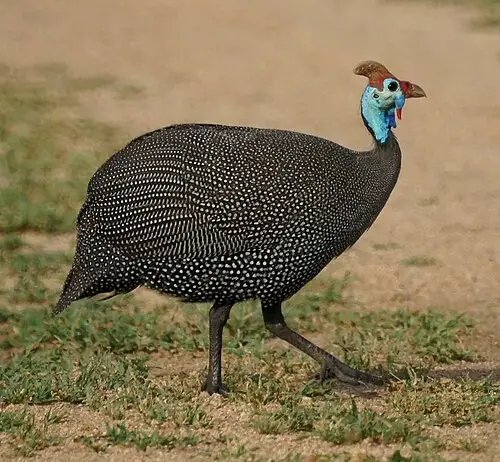
Photo: New Jersey Birds · CC BY-SA 2.0 · Wikimedia Commons Source
Helmeted Guineafowl
Numida meleagris (Helmeted Guineafowl · ホロホロチョウ)
💡 Everyday Comparisons for Size, Mass & Speed
- 💡 It is raised as poultry for meat and eggs, and is also hunted as game in Africa (ADW).
- 💡 Its maximum weight of 1.84 kg is about the size of a large whole raw chicken (Comparison).
Reference standards: coach bus ~12 m, mid-size car ~4.9 m, compact car ~1 t, basketball hoop 3.05 m, credit card 8.56 cm.
Site-computed relative index from recorded values; not a formal scientific metric.
📖 1. Overview
The Helmeted Guineafowl is a ground bird living on African savannas with a bony casque rising from the top of its head.
🦴 2. Anatomy & Morphology
It has a bony helmet (casque) on the crown, featherless blue skin on the face and upper neck, and red-tipped wattles. Its blackish-gray body is densely speckled with white spots.
🔍 3. Ecology & Behavior
It is an omnivore that eats grass seeds, leaves, roots, berries, snails, beetles, insect larvae, small lizards, and mice, and also swallows small stones for its gizzard. Females scrape a hollow in the ground under bushes and lay 6–15 eggs.
🇰🇷 4. Connection to Korea
No direct record connecting this species to Korea has been found.
📚 Sources & References
- • IUCN Red List LC (2018) — https://www.iucnredlist.org/species/22679555/132052202
- • IUCN Red List category LC — latest assessment at iucnredlist.org
- • doi.org — avilist.v2026
- • iucnredlist.org — 132052202
- • wikidata.org — Q251842
- • commons.wikimedia.org — File:Numida meleagris -Kruger National Park, South Africa-8a
- • animaldiversity.org — Numida meleagris
- • Silhouette: PhyloPic — Matías Muñoz · CC0 1.0
Recorded dimensions are widely cited representative estimates from public literature and may vary by study or specimen.