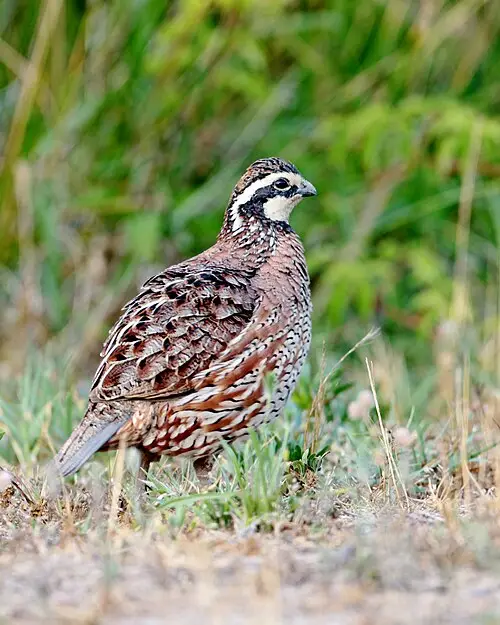
 📸 Photo
Photo: Matt Tillett from Cumberland, MD, USA · CC BY 2.0 · Wikimedia Commons Source
Northern Bobwhite
Colinus virginianus (Northern Bobwhite · コリンウズラ)
💡 Everyday Comparisons for Size, Mass & Speed
- 💡 Its maximum mass of 170 g is about the weight of three chicken eggs, and its length of 24.7 cm is slightly shorter than the long side of an A4 sheet of paper (about 30 cm) (Comparison).
- 💡 It was so popular as a game bird that in 1970 the number hunted in the United States and Canada was estimated at about 35 million (ADW, 'Economic Importance for Humans: Positive').
- 💡 As one of the most extensively studied birds in the world, it has also been used to test the effects of pesticides on wildlife (ADW).
Reference standards: coach bus ~12 m, mid-size car ~4.9 m, compact car ~1 t, basketball hoop 3.05 m, credit card 8.56 cm.
Site-computed relative index from recorded values; not a formal scientific metric.
📖 1. Overview
The northern bobwhite is a small galliform bird with rounded wings and a square tail that favors grassy habitats created by fire, farming, or logging. It is one of the most important game birds in North America.
🦴 2. Anatomy & Morphology
Its body length is 20.3–24.7 cm and its mass is 140–170 g. Males have white stripes on the face and throat whereas females and young birds are buff, and males have distinct black markings on the wing coverts. The base of the lower bill is black in males and yellow in females.
🔍 3. Ecology & Behavior
It mainly eats seeds along with green leaves, fruits, and invertebrates, with plants making up about 85% of its diet. From late summer onward, parents and young form small groups called 'coveys,' and they get most of their water from dew.
🇰🇷 4. Connection to Korea
No direct record connecting this species to Korea has been found.
📚 Sources & References
- • IUCN Red List NT (2021) — https://www.iucnredlist.org/species/22728956/178045540
- • IUCN Red List category NT — latest assessment at iucnredlist.org
- • doi.org — avilist.v2026
- • iucnredlist.org — 178045540
- • wikidata.org — Q142651
- • commons.wikimedia.org — File:Colinus virginianus Chincoteague.jpg
- • animaldiversity.org — Colinus virginianus
- • Silhouette: PhyloPic — Edwin Price · CC BY 4.0
Recorded dimensions are widely cited representative estimates from public literature and may vary by study or specimen.