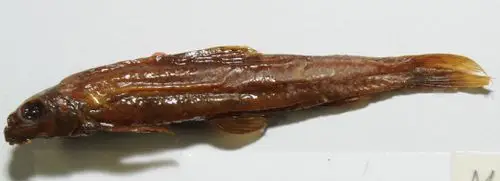
 📸 Photo
Photo: Swedish Museum of Natural History · CC BY 4.0 · Wikimedia Commons Source
Korean sand gudgeon
Microphysogobio koreensis (Korean sand gudgeon · Korean sand gudgeon)
🇰🇷 Class I endangered wildlife (Korea)
💡 Everyday Comparisons for Size, Mass & Speed
- 💡 Its body length of 12 cm is slightly shorter than a ballpoint pen (about 14 cm) (Comparison).
- 💡 Because it feeds on attached algae on bottom stones, its feeding grounds disappear first when a river becomes polluted.
Reference standards: coach bus ~12 m, mid-size car ~4.9 m, compact car ~1 t, basketball hoop 3.05 m, credit card 8.56 cm.
📖 1. Overview
The Korean sand gudgeon is a small freshwater cyprinid fish living only in the Nakdong and Seomjin River systems, similar to Dolmaja (a Korean animal name) but slightly larger.
🦴 2. Anatomy & Morphology
Its body is slender, elongated, and cylindrical, with well-developed small papillae on the lips. It has one pair of thin barbels at the corners of the mouth, a bluish-brown back, and a silvery-white belly.
🔍 3. Ecology & Behavior
It feeds mainly on attached algae on river bottoms and also eats small crustaceans and aquatic insect larvae.
🇰🇷 4. Connection to Korea
It is a Class I endangered wildlife (Korea) species endemic to Korea, living in the Nakdong and Seomjin River systems. Its numbers are rapidly declining due to river construction and water pollution.
📚 Sources & References
- • IUCN Red List EN (2023) — https://www.iucnredlist.org/species/148448179/148448183
- • 멸종위기 야생생물 Ⅰ급 — 국가생물종목록(국립생물자원관) ktsn 120000057587 — https://species.nibr.go.kr/home/mainHome.do?cont_link=009&subMenu=009002&contCd=009002&ktsn=120000057587
- • IUCN Red List category EN — latest assessment at iucnredlist.org
- • Korean protection status: Class I endangered wildlife (Korea)
- • catalogueoflife.org — 433HG
- • iucnredlist.org — 148448183
- • 국가생물종목록(국립생물자원관) ktsn 120000057587 — https://species.nibr.go.kr/home/mainHome.do?cont_link=009&subMenu=009002&contCd=009002&ktsn=120000057587
- • wikidata.org — Q3757250
- • commons.wikimedia.org — File:Microphysogobio koreensis (preserved specimen).jpg
- • fishbase.se — Microphysogobio-koreensis.html
- • species.nibr.go.kr — list
- • Silhouette: PhyloPic — Douglas Teles da Rosa · CC0 1.0 (Related taxon silhouette — Tanichthys albonubes)
Recorded dimensions are widely cited representative estimates from public literature and may vary by study or specimen.