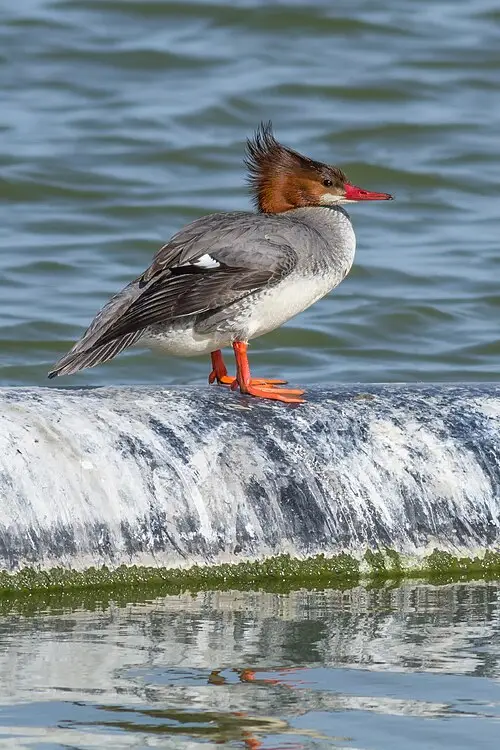
 📸 Photo
Photo: Frank Schulenburg · CC BY-SA 3.0 · Wikimedia Commons Source
Common Merganser
Mergus merganser (Common Merganser · カワアイサ)
💡 Everyday Comparisons for Size, Mass & Speed
- 💡 Its flight speed of 70 km/h is about three to four times the speed of a bicycle, and its wingspan of about 1 m is roughly waist height for an adult.
- 💡 By thinning fish numbers in overcrowded lakes where fish cannot grow large, it helps anglers catch larger fish (ADW, Economic Importance for Humans: Positive).
- 💡 In winter, flocks can be seen diving together to hunt fish on lakes, dams, and reservoirs (National List of Species of Korea).
Reference standards: coach bus ~12 m, mid-size car ~4.9 m, compact car ~1 t, basketball hoop 3.05 m, credit card 8.56 cm.
Site-computed relative index from recorded values; not a formal scientific metric.
📖 1. Overview
The Common Merganser is the largest merganser and the largest inland duck in North America, diving underwater to catch fish. In South Korea, it is a common winter visitor that rarely breeds in mountain valleys of Gangwon Province.
🦴 2. Anatomy & Morphology
Males have a greenish-black head, a white body, and a black back, while females have a brown head and upper neck with a white chin. Both sexes have a long, slender, red bill with a hooked tip and serrated edges.
🔍 3. Ecology & Behavior
It dives by sight in clear water to catch slow, small fish, and also eats insects, frogs, and snails when fish are scarce. In winter it dives in turns in flocks on lakes or rivers, and it lays a clutch of 9–10 eggs and incubates them for 32–35 days.
🇰🇷 4. Connection to Korea
It is listed on the National List of Species of Korea as a nationally common winter visitor and rare resident, with rare breeding recently confirmed in some mountain valleys of Gangwon Province.
📚 Sources & References
- • IUCN Red List LC (2018) — https://www.iucnredlist.org/species/22680492/132054083
- • IUCN Red List category LC — latest assessment at iucnredlist.org
- • doi.org — avilist.v2026
- • iucnredlist.org — 132054083
- • 국가생물종목록(국립생물자원관) ktsn 120000001472 — https://species.nibr.go.kr/home/mainHome.do?cont_link=009&subMenu=009002&contCd=009002&ktsn=120000001472
- • wikidata.org — Q180991
- • commons.wikimedia.org — File:Female Mergus merganser americanus at Las Gallinas Wild
- • animaldiversity.org — Mergus merganser
- • species.nibr.go.kr — mainHome.do
- • Silhouette: PhyloPic — Kai Caspar · CC0 1.0
Recorded dimensions are widely cited representative estimates from public literature and may vary by study or specimen.