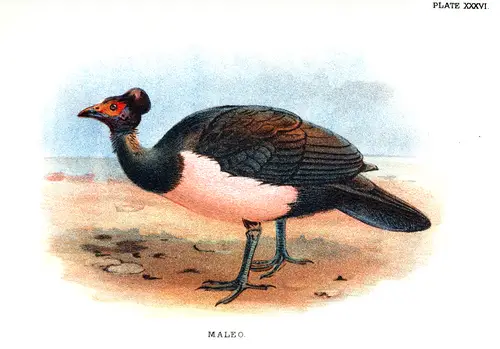
 📸 Photo
Photo: Public domain · Public domain · Wikimedia Commons Source
Maleo
Macrocephalon maleo (Maleo · セレベスツカツクリ)
💡 Everyday Comparisons for Size, Mass & Speed
- 💡 Because its eggs were sold as a luxury delicacy like caviar, nearly all of the eggs disappeared (Alto Conservation newsletter).
- 💡 After villagers shifted from egg poachers to nest guardians and data recorders, chicks began hatching again (Alto Conservation newsletter).
Reference standards: coach bus ~12 m, mid-size car ~4.9 m, compact car ~1 t, basketball hoop 3.05 m, credit card 8.56 cm.
📖 1. Overview
The Maleo is a bird endemic to the Indonesian island of Sulawesi that does not incubate its eggs, instead burying them in sand heated by the sun or geothermal energy.
🦴 2. Anatomy & Morphology
Each egg is very large, and the mother digs a deep sand pit with her feet. Newly hatched chicks also kick their way up through the sand.
🔍 3. Ecology & Behavior
Pairs bond for life and walk from the forest to communal nesting grounds, where they dig deep into the sand, bury a single egg, and leave. The egg incubates in the sand for about 80 days before hatching.
🇰🇷 4. Connection to Korea
No direct record connecting this species to Korea has been found.
📚 Sources & References
- • IUCN Red List CR (2021) — https://www.iucnredlist.org/species/22678576/194673255
- • IUCN Red List category CR — latest assessment at iucnredlist.org
- • doi.org — avilist.v2026
- • iucnredlist.org — 194673255
- • wikidata.org — Q836291
- • commons.wikimedia.org — File:Maleo bird.PNG
- • tompotika.org — AlTo Newsletter 2010 Feb.pdf
- • Silhouette: PhyloPic — Kai Caspar · CC0 1.0
Recorded dimensions are widely cited representative estimates from public literature and may vary by study or specimen.