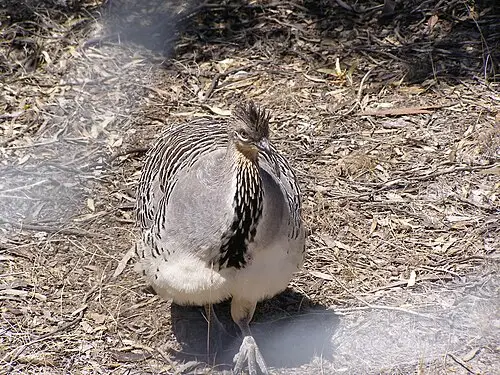
 📸 Photo
Photo: Kr.afol at English Wikipedia · CC BY-SA 3.0 · Wikimedia Commons Source
Malleefowl
Leipoa ocellata (Malleefowl · クサムラツカツクリ)
💡 Everyday Comparisons for Size, Mass & Speed
- 💡 Its body length of 60 cm is slightly shorter than an adult's arm, and its maximum weight of 2.5 kg is about one 2 L bottle of water plus one 0.5 L bottle (Comparison).
- 💡 Instead of sitting on the eggs, the male tends the mound to keep the egg chamber at about 34°C, similar to regulating temperature in an egg incubator (Comparison, New South Wales Government account).
- 💡 Chicks can walk as soon as they emerge from the mound, run within 2 hours, and fly within a day (New South Wales Government account).
Reference standards: coach bus ~12 m, mid-size car ~4.9 m, compact car ~1 t, basketball hoop 3.05 m, credit card 8.56 cm.
Site-computed relative index from recorded values; not a formal scientific metric.
📖 1. Overview
The Malleefowl is a ground-dwelling bird living in mallee scrub in arid regions of Australia that builds a large mound of soil and leaf litter to incubate its eggs inside. It is listed as Vulnerable (VU, 2022 assessment) on the IUCN Red List.
🦴 2. Anatomy & Morphology
Measuring about 60 cm in body length, about 43 cm in height, and 1.5–2.5 kg in weight, this ground bird has strong legs and raises its head crest when startled. Its camouflaged plumage blends well into the scrub.
🔍 3. Ecology & Behavior
It eats seeds of shrubs such as acacia, shoots, flowers, and fruits of herbs and shrubs, and insects such as cockroaches and ants. Its eggs are incubated inside a large mound of sandy soil where the male keeps the egg chamber at about 34°C. It usually lays 15–24 eggs (up to 34) per year, and chicks hatch after 49–96 days (averaging about 60 days).
🇰🇷 4. Connection to Korea
No direct record connecting this species to Korea has been found.
📚 Sources & References
- • IUCN Red List VU (2022) — https://www.iucnredlist.org/species/22678646/212766400
- • IUCN Red List category VU — latest assessment at iucnredlist.org
- • doi.org — avilist.v2026
- • iucnredlist.org — 212766400
- • wikidata.org — Q901228
- • commons.wikimedia.org — File:Leipoa ocellata.jpg
- • threatenedspecies.bionet.nsw.gov.au — profile
- • Silhouette: PhyloPic — Rachel T Mason · CC0 1.0
Recorded dimensions are widely cited representative estimates from public literature and may vary by study or specimen.