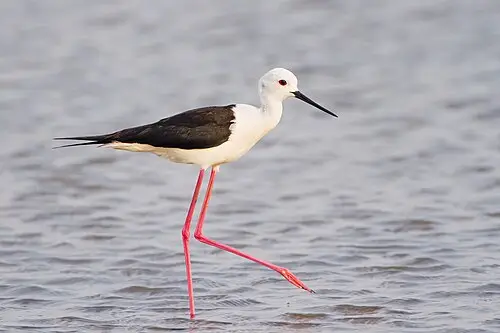
 📸 Photo
Photo: JJ Harrison ( https://www.jjharrison.com.au/ ) · CC BY-SA 3.0 · Wikimedia Commons Source
Black-winged Stilt
Himantopus himantopus (Black-winged Stilt · セイタカシギ)
💡 Everyday Comparisons for Size, Mass & Speed
- 💡 Its body length of 37 cm is about 8 cm longer than the long side of an A4 sheet of paper (29.7 cm) (Comparison).
- 💡 It is notable for building its nest among young rice plants in flooded paddies during the rice-planting season (National List of Species of Korea).
- 💡 Since breeding was first confirmed on reclaimed land in Seosan in 1998, new breeding sites have continued to increase (National List of Species of Korea).
Reference standards: coach bus ~12 m, mid-size car ~4.9 m, compact car ~1 t, basketball hoop 3.05 m, credit card 8.56 cm.
📖 1. Overview
The Black-winged Stilt is a shorebird with a thin, long bill and long pink legs. It is widely distributed across south-central Eurasia, Africa, India, Australia, and the Americas.
🦴 2. Anatomy & Morphology
Its bill is black and slender, and its legs are long and pink. Its wings are black, its underparts are white, and males have a greenish gloss on the upperparts.
🔍 3. Ecology & Behavior
It catches fish, insects, and crustaceans in shallow water and forms small family flocks. It builds a mound nest of rice stubble and stems among young rice plants in paddies, where males and females take turns incubating 4 eggs for 22–24 days.
🇰🇷 4. Connection to Korea
In Korea, it is an uncommon passage migrant passing through flooded rice paddies and rivers. Since its first breeding was reported at Cheonsuman Bay in 1998, breeding has also been recorded at Yeongamho Lake and Songdo in Incheon.
📚 Sources & References
- • IUCN Red List LC (2025) — https://www.iucnredlist.org/species/22727969/281850195
- • IUCN Red List category LC — latest assessment at iucnredlist.org
- • doi.org — avilist.v2026
- • iucnredlist.org — 281850195
- • 국가생물종목록(국립생물자원관) ktsn 120000001664 — https://species.nibr.go.kr/home/mainHome.do?cont_link=009&subMenu=009002&contCd=009002&ktsn=120000001664
- • wikidata.org — Q178821
- • commons.wikimedia.org — File:Himantopus himantopus - Pak Thale.jpg
- • species.nibr.go.kr — mainHome.do
- • Silhouette: PhyloPic — Edwin Price · CC BY 4.0
Recorded dimensions are widely cited representative estimates from public literature and may vary by study or specimen.