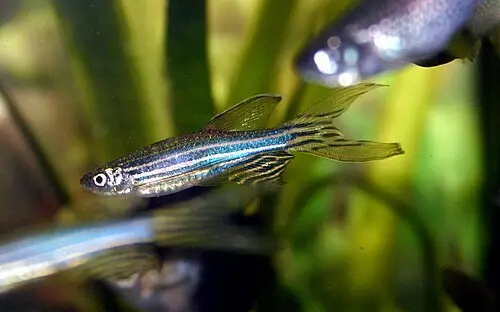
 📸 Photo
Photo: Marrabbio2 · Public domain · Wikimedia Commons Source
Zebra danio
Danio rerio (Zebra danio · ゼブラフィッシュ)
💡 Everyday Comparisons for Size, Mass & Speed
- 💡 Its average length of 25 mm is almost equal to the diameter of a Korean 500-won coin (about 26.5 mm) (Comparison).
- 💡 Used as a biological research model organism since 1981, it is widely employed in studies of vertebrate development, genetics, and disease (ADW).
- 💡 It is popular as a pet aquarium fish, and genetically modified varieties that glow in the dark are also sold in the aquarium trade (ADW).
Reference standards: coach bus ~12 m, mid-size car ~4.9 m, compact car ~1 t, basketball hoop 3.05 m, credit card 8.56 cm.
📖 1. Overview
The Zebra danio is a small freshwater fish with horizontal stripes along its sides that lives in shallow waters such as streams and rice paddies in South Asia. It is widely known as a research model organism and an aquarium fish.
🦴 2. Anatomy & Morphology
Its body is spindle-shaped and flattened from side to side with an upturned mouth, and it usually has 5–7 longitudinal stripes along the sides of its body. Having no stomach or teeth, it grinds up food with its gill rakers.
🔍 3. Ecology & Behavior
It mainly eats zooplankton and aquatic insects, also feeds on insects at the water surface, and readily eats mosquito larvae. It lives in schools and breeds during the rainy season, with spawning starting at first light in the morning and continuing for about an hour.
🇰🇷 4. Connection to Korea
No direct record connecting this species to Korea has been found.
📚 Sources & References
- • IUCN Red List LC (2010) — https://www.iucnredlist.org/species/166487/6219667
- • IUCN Red List category LC — latest assessment at iucnredlist.org
- • catalogueoflife.org — 3443J
- • iucnredlist.org — 6219667
- • wikidata.org — Q169444
- • animaldiversity.org — Danio rerio
- • fishbase.se — Danio-rerio.html
- • Silhouette: PhyloPic — Arcadia Science · CC0 1.0
Recorded dimensions are widely cited representative estimates from public literature and may vary by study or specimen.