 📸 Photo
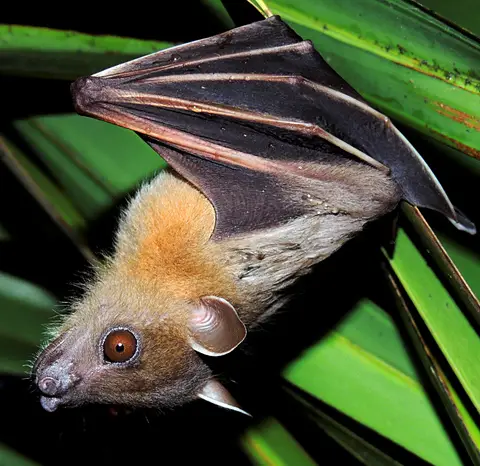
Photo: Shantanu Kuveskar · CC BY-SA 4.0 · Wikimedia Commons Source
Greater Short-nosed Fruit Bat
Cynopterus sphinx (Greater Short-nosed Fruit Bat · Greater Short-nosed Fruit Bat)
💡 Everyday Comparisons for Size, Mass & Speed
- 💡 It disperses date palm seeds and pollinates many night-blooming flowers.
- 💡 It also likes fruits that people eat, such as guavas, bananas, dates, and lychees.
- 💡 Its average weight of 75 g is slightly heavier than one chicken egg (about 60 g) (Comparison).
Reference standards: coach bus ~12 m, mid-size car ~4.9 m, compact car ~1 t, basketball hoop 3.05 m, credit card 8.56 cm.
Site-computed relative index from recorded values; not a formal scientific metric.
📖 1. Overview
The Greater Short-nosed Fruit Bat is a fruit bat living in tropical forests and near orchards that chews palm fronds to make tents.
🦴 2. Anatomy & Morphology
It has a relatively long snout, typically bright orange upperparts with paler underparts, and very fine, silky fur.
🔍 3. Ecology & Behavior
A frugivore that finds food by scent, it can eat more than its body weight in a single sitting. It roosts in same-sex groups of 8–9 individuals until the breeding season, when 6–10 males and 10–15 females gather in palm frond tents; in central India, females give birth to a single young twice a year.
🇰🇷 4. Connection to Korea
No direct record connecting this species to Korea has been found.
📚 Sources & References
- • IUCN Red List LC (2019) — https://www.iucnredlist.org/species/6106/22113656
- • IUCN Red List category LC — latest assessment at iucnredlist.org
- • mammaldiversity.org — 1004379
- • iucnredlist.org — 22113656
- • wikidata.org — Q1340212
- • commons.wikimedia.org — File:Short-nosed Fruit Bat (Cynopterus sphinx) Photograph By
- • animaldiversity.org — Cynopterus sphinx
- • Silhouette: PhyloPic — Baheerathan Murugavel · CC0 1.0
Recorded dimensions are widely cited representative estimates from public literature and may vary by study or specimen.