 📸 Photo
Photo: Pascal Aleixandre · CC BY-SA 3.0 · Wikimedia Commons Source
Whooper Swan
Cygnus cygnus (Whooper Swan · オオハクチョウ)
🇰🇷 Class II endangered wildlife (Korea) · Natural Monument (Korea) «Whooper Swan»
💡 Everyday Comparisons for Size, Mass & Speed
- 💡 A large white bird seen on lakes and river estuaries in winter, the Korea Heritage Service groups three species—the tundra swan, whooper swan, and mute swan—together in its description.
- 💡 Its body length of 152 cm is similar to the height of an upper-grade elementary school child (Comparison).
- 💡 An average male mass of 9.8 kg is similar to a 10 kg bag of rice (Comparison).
Reference standards: coach bus ~12 m, mid-size car ~4.9 m, compact car ~1 t, basketball hoop 3.05 m, credit card 8.56 cm.
Site-computed relative index from recorded values; not a formal scientific metric.
📖 1. Overview
The whooper swan is a large swan that breeds in northern Eurasia and visits the east and south coasts of Korea in winter.
🦴 2. Anatomy & Morphology
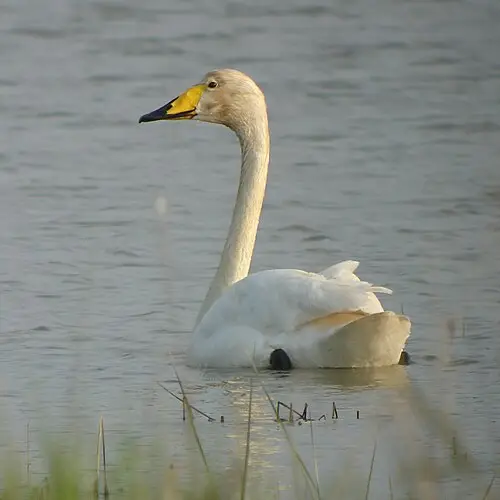
Its body is all white, its legs are black, and its bill is yellow at the base and black at the tip. The tip of its bill is slightly hooked, and it holds its neck upright when swimming.
🔍 3. Ecology & Behavior
It feeds on aquatic plants and roots in shallow water, digging in mud with its webbed feet, and in winter it also eats farm crops. It lays 1–8 eggs per clutch and incubates them for 30–32 days.
🇰🇷 4. Connection to Korea
It is a Class II endangered wildlife (Korea) species and was designated a Natural Monument (Korea) on May 31, 1968 (1968-05-31). Arriving in autumn to escape the cold, it spends the winter along the east and south coasts.
📚 Sources & References
- • IUCN Red List LC (2025) — https://www.iucnredlist.org/species/22679856/281843607
- • 멸종위기 야생생물 Ⅱ급 · 천연기념물 «큰고니» — 국가생물종목록(국립생물자원관) ktsn 120000001427 — https://species.nibr.go.kr/home/mainHome.do?cont_link=009&subMenu=009002&contCd=009002&ktsn=120000001427
- • IUCN Red List category LC — latest assessment at iucnredlist.org
- • Korean protection status: Class II endangered wildlife (Korea) · Natural Monument (Korea) «Whooper Swan»
- • doi.org — avilist.v2026
- • iucnredlist.org — 281843607
- • 국가생물종목록(국립생물자원관) ktsn 120000001427 — https://species.nibr.go.kr/home/mainHome.do?cont_link=009&subMenu=009002&contCd=009002&ktsn=120000001427
- • heritage.go.kr — culSelectDetail.do
- • wikidata.org — Q25612
- • commons.wikimedia.org — File:Cygnus cygnus 070416 IOL.jpg
- • animaldiversity.org — Cygnus cygnus
- • heritage.go.kr — cul 1369902010200.html
- • audubon.org — whooper-swan
- • species.nibr.go.kr — general-search
- • Silhouette: PhyloPic — Andrew Cho · CC BY 4.0
Recorded dimensions are widely cited representative estimates from public literature and may vary by study or specimen.