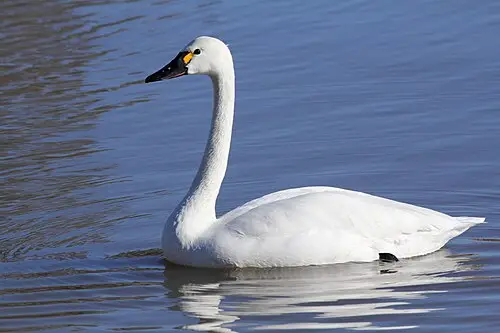
 📸 Photo
Photo: Dominic Sherony · CC BY-SA 2.0 · Wikimedia Commons Source
Tundra Swan
Cygnus columbianus (Tundra Swan · コハクチョウ)
🇰🇷 Class I endangered wildlife (Korea) · Natural Monument (Korea) «Tundra Swan»
💡 Everyday Comparisons for Size, Mass & Speed
- 💡 Frequently seen in winter at wetlands near farmlands, it also eats leftover grain in harvested fields (ADW, Audubon).
- 💡 Its body length of 120 cm is similar to the height of a lower-grade elementary school child (Comparison).
- 💡 Its maximum mass of 9.1 kg is slightly lighter than a 10 kg bag of rice (Comparison).
Reference standards: coach bus ~12 m, mid-size car ~4.9 m, compact car ~1 t, basketball hoop 3.05 m, credit card 8.56 cm.
Site-computed relative index from recorded values; not a formal scientific metric.
📖 1. Overview
The tundra swan is a swan smaller than the whooper swan that breeds on Arctic tundra and visits the east and south coasts of Korea in winter.
🦴 2. Anatomy & Morphology
Both sexes have a white body, black bill and legs, and a yellow patch near the base of the bill. Young birds have a pale greyish-brown body and a pinkish bill.
🔍 3. Ecology & Behavior
It eats the stems and roots of grasses, sedges, and smartweeds, reaching depths of up to 1 m by submerging its head and neck. It lays 3–7 eggs (averaging 5) per clutch and incubates them for 31–33 days.
🇰🇷 4. Connection to Korea
It is a Class I endangered wildlife (Korea) species and was designated a Natural Monument (Korea) on May 31, 1968 (1968-05-31). Young tundra swans spend the winter mixed in among flocks of whooper swans.
📚 Sources & References
- • IUCN Red List LC (2025) — https://www.iucnredlist.org/species/22679862/269937332
- • 멸종위기 야생생물 Ⅰ급 · 천연기념물 «고니» — 국가생물종목록(국립생물자원관) ktsn 120000001426 — https://species.nibr.go.kr/home/mainHome.do?cont_link=009&subMenu=009002&contCd=009002&ktsn=120000001426
- • IUCN Red List category LC — latest assessment at iucnredlist.org
- • Korean protection status: Class I endangered wildlife (Korea) · Natural Monument (Korea) «Tundra Swan»
- • doi.org — avilist.v2026
- • iucnredlist.org — 269937332
- • 국가생물종목록(국립생물자원관) ktsn 120000001426 — https://species.nibr.go.kr/home/mainHome.do?cont_link=009&subMenu=009002&contCd=009002&ktsn=120000001426
- • heritage.go.kr — culSelectDetail.do
- • wikidata.org — Q26603
- • commons.wikimedia.org — File:Tundra Swan (Cygnus columbianus) (8571142484).jpg
- • animaldiversity.org — Cygnus columbianus
- • heritage.go.kr — cul 1369902010100.html
- • audubon.org — tundra-swan
- • species.nibr.go.kr — general-search
- • Silhouette: PhyloPic — Andy Wilson · CC0 1.0
Recorded dimensions are widely cited representative estimates from public literature and may vary by study or specimen.