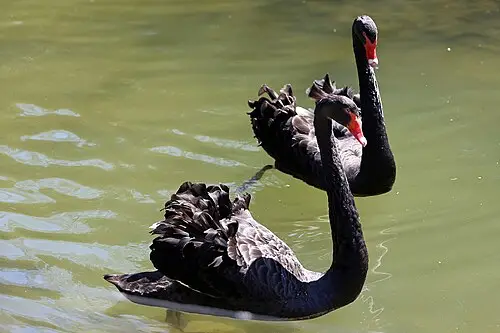
 📸 Photo
Photo: W. Bulach · CC BY-SA 4.0 · Wikimedia Commons Source
Black Swan
Cygnus atratus (Black Swan · コクチョウ)
💡 Everyday Comparisons for Size, Mass & Speed
- 💡 Its wingspan of 2 m is taller than an adult human, and its maximum mass of 8.7 kg is slightly lighter than a 10 kg bag of rice (Comparison).
- 💡 People eat its eggs or keep it as a pet, and it is also popular with birdwatchers (ADW, 'Economic Importance for Humans: Positive').
Reference standards: coach bus ~12 m, mid-size car ~4.9 m, compact car ~1 t, basketball hoop 3.05 m, credit card 8.56 cm.
Site-computed relative index from recorded values; not a formal scientific metric.
📖 1. Overview
The black swan is a large, mostly black swan that lives on lakes, rivers, and swamps rich in aquatic plants. Swans are the largest of all waterfowl.
🦴 2. Anatomy & Morphology
It has the classic swan silhouette with a long arched neck and raised eyebrow-like ridges. Its plumage is mostly black with some white wing feathers, its eyes are red or pinkish, and its red bill is crossed by a white band. Males are slightly larger than females.
🔍 3. Ecology & Behavior
An herbivore that uses its long neck to graze on underwater plants and occasionally eats insects, it is the least territorial of all swans, forming flocks and sometimes nesting in colonies. Pairs often stay together for life and wander when food is scarce.
🇰🇷 4. Connection to Korea
No direct record connecting this species to Korea has been found.
📚 Sources & References
- • IUCN Red List LC (2018) — https://www.iucnredlist.org/species/22679843/131907524
- • IUCN Red List category LC — latest assessment at iucnredlist.org
- • doi.org — avilist.v2026
- • iucnredlist.org — 131907524
- • wikidata.org — Q131044
- • commons.wikimedia.org — File:00 2102 Trauerschwäne (Breisach am Rhein).jpg
- • animaldiversity.org — Cygnus atratus
- • Silhouette: PhyloPic — An Ignorant Atheist · CC0 1.0 (Congeneric silhouette — Cygnus olor)
Recorded dimensions are widely cited representative estimates from public literature and may vary by study or specimen.