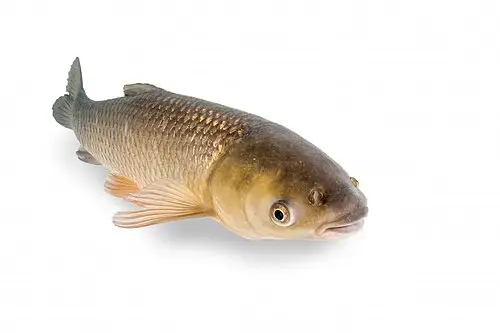
 📸 Photo
Photo: Hagerty, Ryan/USFWS · Public domain · Wikimedia Commons Source
Grass carp
Ctenopharyngodon idella (Grass carp · ソウギョ)
💡 Everyday Comparisons for Size, Mass & Speed
- 💡 Its maximum total length of 1.5 m reaches above an adult's waist height (Comparison).
- 💡 Its maximum weight of 45 kg is just over two 20 kg bags of rice (Comparison).
- 💡 It is one of the world's most important aquaculture species and is also used to control aquatic weeds in rivers, fish ponds, and reservoirs (FishBase).
- 💡 In Korea, it can be seen in reservoirs and dams (National List of Species of Korea).
Reference standards: coach bus ~12 m, mid-size car ~4.9 m, compact car ~1 t, basketball hoop 3.05 m, credit card 8.56 cm.
Site-computed relative index from recorded values; not a formal scientific metric.
📖 1. Overview
The Grass carp is a large herbivorous freshwater fish that eats aquatic plants; originally native to eastern East Asia (China and the Amur River in Russia), it has been introduced around the world for aquaculture. In Korea, it can be seen in reservoirs and dams.
🦴 2. Anatomy & Morphology
Its body is an elongated spindle shape, dark gray on the back and silvery white on the sides and belly. The upper and lower lobes of its tail fin have the same shape.
🔍 3. Ecology & Behavior
It is an herbivore that selectively feeds on submerged plants and aquatic weeds, and also takes detritus, insects, and invertebrates. In June and July, it lays 500,000–800,000 eggs on sandy and muddy river bottoms.
🇰🇷 4. Connection to Korea
It is listed on the National List of Species of Korea and lives in reservoirs and dams across Korea.
📚 Sources & References
- • IUCN Red List LC (2022) — https://www.iucnredlist.org/species/61295/3102796
- • IUCN Red List category LC — latest assessment at iucnredlist.org
- • catalogueoflife.org — 326B3
- • iucnredlist.org — 3102796
- • 국가생물종목록(국립생물자원관) ktsn 120000057554 — https://species.nibr.go.kr/home/mainHome.do?cont_link=009&subMenu=009002&contCd=009002&ktsn=120000057554
- • wikidata.org — Q76098
- • commons.wikimedia.org — File:Grass carp portrait.jpg
- • fishbase.se — Ctenopharyngodon-idella.html
- • species.nibr.go.kr — mainHome.do
- • Silhouette: PhyloPic — Carlos Cano-Barbacil · CC0 1.0 (Related taxon silhouette — Luciobarbus graellsii)
Recorded dimensions are widely cited representative estimates from public literature and may vary by study or specimen.