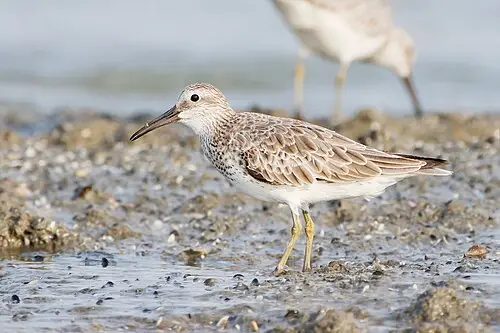
 📸 Photo
Photo: JJ Harrison ( https://www.jjharrison.com.au/ ) · CC BY-SA 3.0 · Wikimedia Commons Source
Great Knot
Calidris tenuirostris (Great Knot · オバシギ)
🇰🇷 Class II endangered wildlife (Korea)
💡 Everyday Comparisons for Size, Mass & Speed
- 💡 Its mass of about 145 g is around two and a half chicken eggs (one egg is about 60 g) (Comparison).
- 💡 Its body length of about 27 cm is slightly shorter than the long side of an A4 sheet of paper (29.7 cm) (Comparison).
Reference standards: coach bus ~12 m, mid-size car ~4.9 m, compact car ~1 t, basketball hoop 3.05 m, credit card 8.56 cm.
Site-computed relative index from recorded values; not a formal scientific metric.
📖 1. Overview
The great knot is a sandpiper that breeds in northeastern Siberia and winters across wide tidal flats stretching from the Middle East to Australia. On the IUCN Red List, it is Endangered (EN).
🦴 2. Anatomy & Morphology
It is a medium-sized sandpiper about 27 cm long and weighing about 145 g.
🔍 3. Ecology & Behavior
In northwestern Australia it eats small bivalves, gastropods, brachiopods, and crustaceans such as shrimp and crabs. During the breeding season pairs live scattered at low density and lay 4 eggs in a mossy hollow on the ground.
🇰🇷 4. Connection to Korea
In Korea, it is protected as a Class II endangered wildlife (Korea) species.
📚 Sources & References
- • IUCN Red List EN (2025) — https://www.iucnredlist.org/species/22693359/254641184
- • 멸종위기 야생생물 Ⅱ급 — 국가생물종목록(국립생물자원관) ktsn 120000001729 — https://species.nibr.go.kr/home/mainHome.do?cont_link=009&subMenu=009002&contCd=009002&ktsn=120000001729
- • IUCN Red List category EN — latest assessment at iucnredlist.org
- • Korean protection status: Class II endangered wildlife (Korea)
- • doi.org — avilist.v2026
- • iucnredlist.org — 254641184
- • 국가생물종목록(국립생물자원관) ktsn 120000001729 — https://species.nibr.go.kr/home/mainHome.do?cont_link=009&subMenu=009002&contCd=009002&ktsn=120000001729
- • wikidata.org — Q18876
- • commons.wikimedia.org — File:Calidris tenuirostris - Laem Phak Bia.jpg
- • nzbirdsonline.org.nz — great-knot
- • Silhouette: PhyloPic — Edwin Price · CC0 1.0 (Congeneric silhouette — Calidris pugnax)
Recorded dimensions are widely cited representative estimates from public literature and may vary by study or specimen.