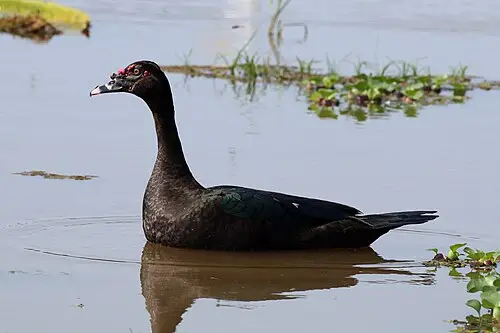
 📸 Photo
Photo: Charles J. Sharp · CC BY-SA 4.0 · Wikimedia Commons Source
Muscovy Duck
Cairina moschata (Muscovy Duck · ノバリケン)
💡 Everyday Comparisons for Size, Mass & Speed
- 💡 Its average mass of 4.3 kg is less than half of a 10 kg bag of rice, and its wingspan of 1.45 m is slightly shorter than an adult's height (Comparison).
- 💡 Domesticated Muscovy ducks are raised for meat, and placing them in cow pens is known to reduce flies by 80–90% (ADW, 'Economic Importance for Humans: Positive').
- 💡 They are used on farms to catch pests such as flies, snails, locusts, and slugs, and are also kept by poultry enthusiasts (ADW).
Reference standards: coach bus ~12 m, mid-size car ~4.9 m, compact car ~1 t, basketball hoop 3.05 m, credit card 8.56 cm.
Site-computed relative index from recorded values; not a formal scientific metric.
📖 1. Overview
The Muscovy duck is a large duck averaging 4.3 kg that lives in lakeside and riverside woods and roosts in trees at night. Domestic varieties range in color from white to pied, brown, and blue.
🦴 2. Anatomy & Morphology
It has red, fleshy bumps on the face, a brownish-black body with iridescent green and purple gloss on the back, and white wing patches. Males are larger than females.
🔍 3. Ecology & Behavior
It is an omnivore that eats the roots, stems, leaves, and seeds of aquatic and land plants along with small fish, reptiles, crustaceans, insects, millipedes, and termites. Dominant males hold territories and raise their crests in display, and the species is active by day and non-migratory.
🇰🇷 4. Connection to Korea
No direct record connecting this species to Korea has been found.
📚 Sources & References
- • IUCN Red List LC (2018) — https://www.iucnredlist.org/species/22680061/131911211
- • IUCN Red List category LC — latest assessment at iucnredlist.org
- • doi.org — avilist.v2026
- • iucnredlist.org — 131911211
- • wikidata.org — Q242851
- • commons.wikimedia.org — File:Muskovy duck (Cairina moschata).JPG
- • animaldiversity.org — Cairina moschata
- • Silhouette: PhyloPic — Caleb M. Gordon · CC0 1.0
Recorded dimensions are widely cited representative estimates from public literature and may vary by study or specimen.