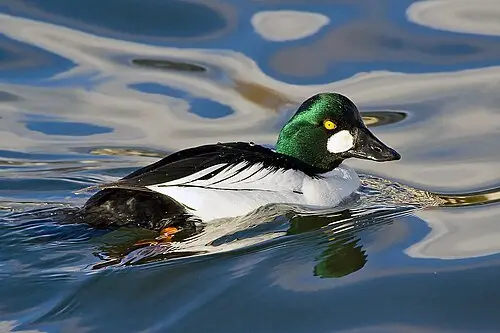
 📸 Photo
Photo: Calibas · CC BY-SA 3.0 · Wikimedia Commons Source
Common Goldeneye
Bucephala clangula (Common Goldeneye · ホオジロガモ)
💡 Everyday Comparisons for Size, Mass & Speed
- 💡 A male's mass of about 1 kg is similar to a 1 kg bag of sugar, and its length of 51 cm is slightly longer than an adult arm (Comparison).
- 💡 In winter, small flocks can be seen at estuaries, lakes, and rivers diving to catch fish and crustaceans (National List of Species of Korea).
- 💡 It is hunted in many parts of the world and used as food (ADW, 'Economic Importance for Humans: Positive').
Reference standards: coach bus ~12 m, mid-size car ~4.9 m, compact car ~1 t, basketball hoop 3.05 m, credit card 8.56 cm.
Site-computed relative index from recorded values; not a formal scientific metric.
📖 1. Overview
The common goldeneye is a medium-sized diving duck that breeds across northern Eurasia and North America and winters as far north as ice-free waters allow. In Korea, it is a common winter visitor.
🦴 2. Anatomy & Morphology
Males have a mostly white body, a dark greenish head with a bluish sheen, and a round white spot below the eye near the base of the bill. Females have a brown head, a grey body, a white neck ring, and a yellow spot at the tip of the bill.
🔍 3. Ecology & Behavior
It dives for crustaceans, mollusks, fish, and aquatic plants, and eats many aquatic insects during the breeding season. It lays 6–15 eggs per clutch that the female incubates for 27–32 days, and is known to nest in tree cavities. Pairs form around December (month 12), and the male leaves the female around the start of incubation.
🇰🇷 4. Connection to Korea
It is listed on the National List of Species of Korea as a common winter visitor observed at wetlands across the country in winter.
📚 Sources & References
- • IUCN Red List LC (2018) — https://www.iucnredlist.org/species/22680455/132529366
- • IUCN Red List category LC — latest assessment at iucnredlist.org
- • doi.org — avilist.v2026
- • iucnredlist.org — 132529366
- • 국가생물종목록(국립생물자원관) ktsn 120000001467 — https://species.nibr.go.kr/home/mainHome.do?cont_link=009&subMenu=009002&contCd=009002&ktsn=120000001467
- • wikidata.org — Q29865
- • commons.wikimedia.org — File:Common Goldeneye.jpg
- • animaldiversity.org — Bucephala clangula
- • species.nibr.go.kr — mainHome.do
- • Silhouette: PhyloPic — Andy Wilson · CC0 1.0
Recorded dimensions are widely cited representative estimates from public literature and may vary by study or specimen.